NIS2 assessment: demonstrate your compliance
- Map of your systems and data flows
- Gaps against the ten measures of Article 21
- Risk priced in euros and a roadmap
- Audit file, insurer and customer questionnaires pre-filled
Ekera reads your documents, your tools and your accounts, interviews your teams, then calculates what an attack or an outage would stop in your business and what it would cost. It proposes the work that cuts risk the most for three budgets, and prepares your NIS2 evidence. In a few days, at a fixed price, with no access to your systems for the assessment.
Hosted in France · Assessment with no access to your systems · AI proposes, you decide| Indicator | Today | After the work |
|---|---|---|
| Maximum outage after an attack | 81% | 34% |
| Worst case | €2.4M to €4.9M | €0.9M to €1.8M |
| Expected annual loss | €150k to €980k | €40k to €260k |
| Weak entry points | 5 | 1 |
| Backups out of reach | no | yes |
| NIS2 checkpoints met | 9 of 20 | 16 of 20 |
Meanwhile, cyber insurance rates are falling: −5% worldwide in the second quarter of 2026, the twelfth quarter of decline in a row. Insurers will have to tell well-protected companies from the rest.
And attacks are changing scale: in July 2026, Hugging Face confirmed an intrusion carried out by an autonomous AI agent. At that speed there is no time left to react. It is the architecture of the information system that limits the damage.
In France, the law transposing NIS2 has not been passed yet. But your customers, your insurers and your buyers are already asking the same questions.
Sources: AMRAE, LUCY 2026 study (2025 data); Marsh, Q2 2026 ; Security Magazine and IT-Connect, July 2026; Vincent Strubel, Director General of ANSSI, December 2024; Référentiel Cyber France (ReCyF) v2.5, objective 5, working draft of 17 March 2026.
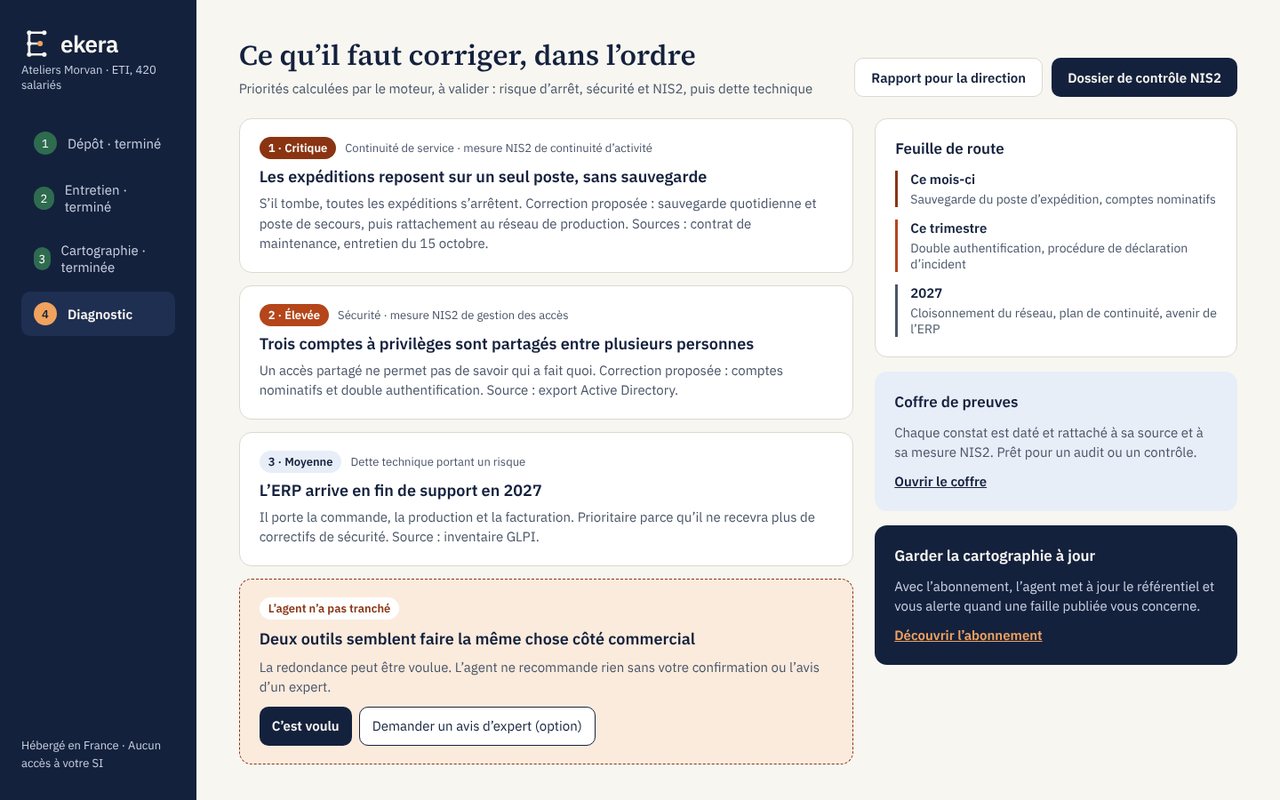
Figures are calculated by an engine, not made up by the AI: same data, same result. When the agent is unsure, it says so, and an expert checks.
Ekera translates outages into euros from your accounts, not from estimates typed in by hand. Then, for three budgets, it searches for the combination of work that cuts risk the most.
The French standard accounting entries file (FEC), which every company in France can produce, gives revenue and variable costs. Margin is split across your revenue streams, so each stream is counted only once. The worst case is broken down line by line and compared with your insurance limit.
For each budget, the engine evaluates every combination of work in the catalogue and keeps the best one; no item in it is superfluous. You see the cost, the loss avoided and the NIS2 measures covered.
Today, the costs shown are illustrative orders of magnitude, to be confirmed by quotes. Each amount shows its confidence level. If the ranking of variants changes between the low and high ends of the price ranges, Ekera flags it.
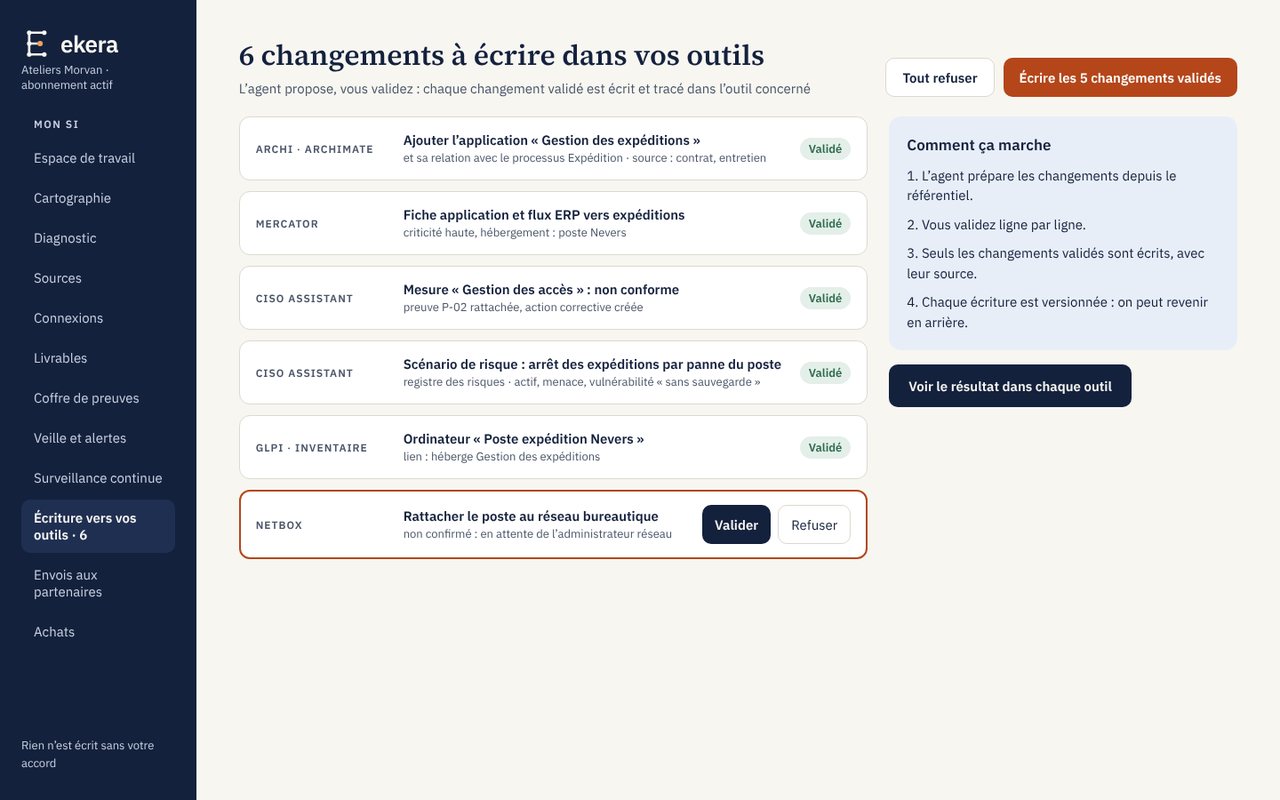
A work scenario goes through an approval flow before anything is written into your tools. For each decision-maker, Ekera prepares the page that concerns them, calculated by the engine.
Each person approves, rejects or asks for a change from their email or Teams. The flow adapts to your organisation: the CFO only above a certain amount, for example. The decision and the opinions are recorded; nothing is written into your tools before that.
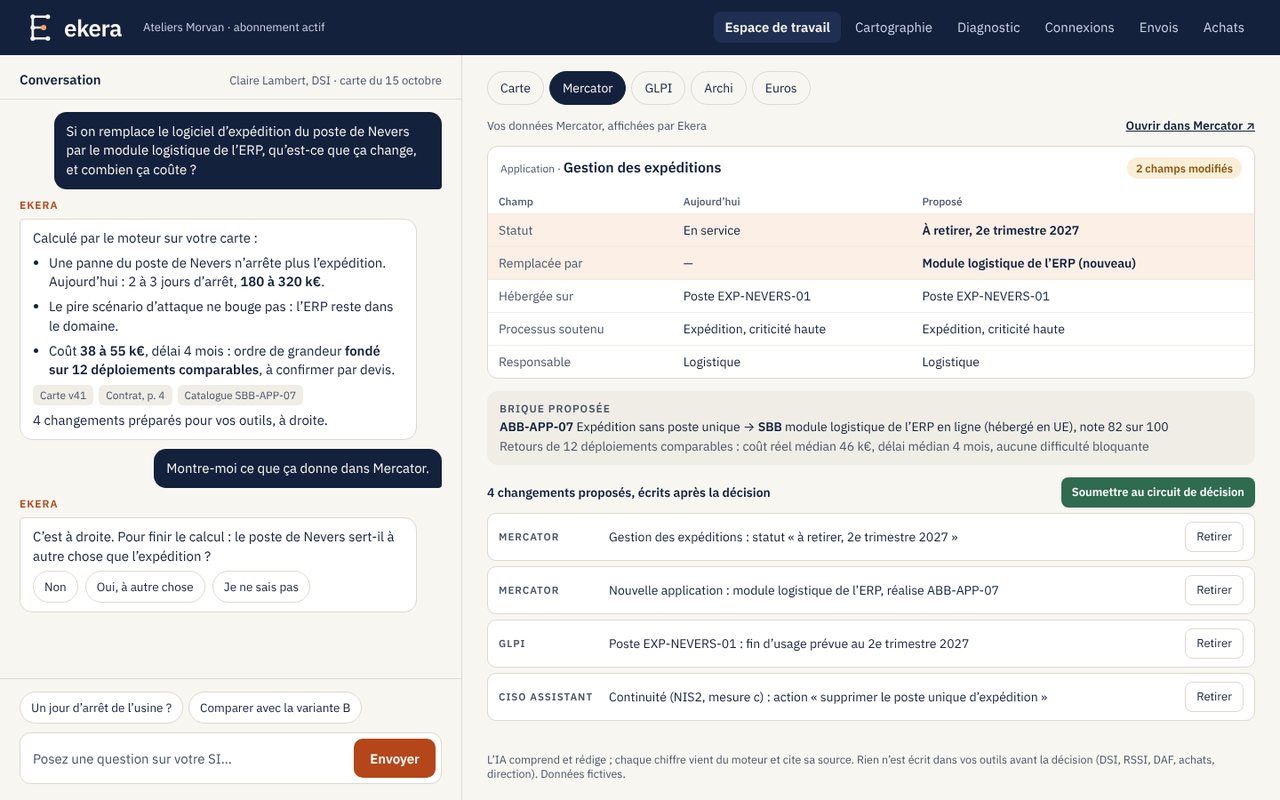
The screens show a fictitious company, Ateliers Morvan, an industrial mid-sized company with 420 employees. They are mock-ups: the product is being built with its first customers.
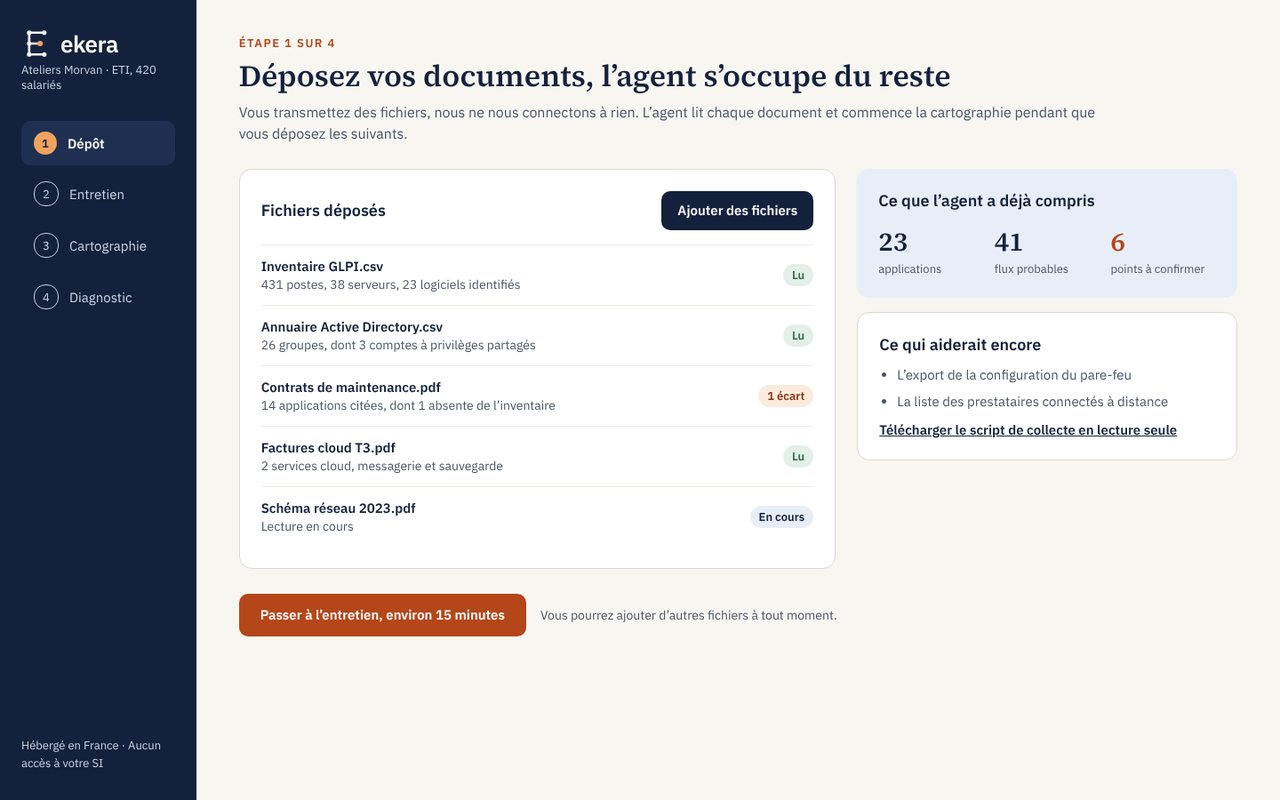
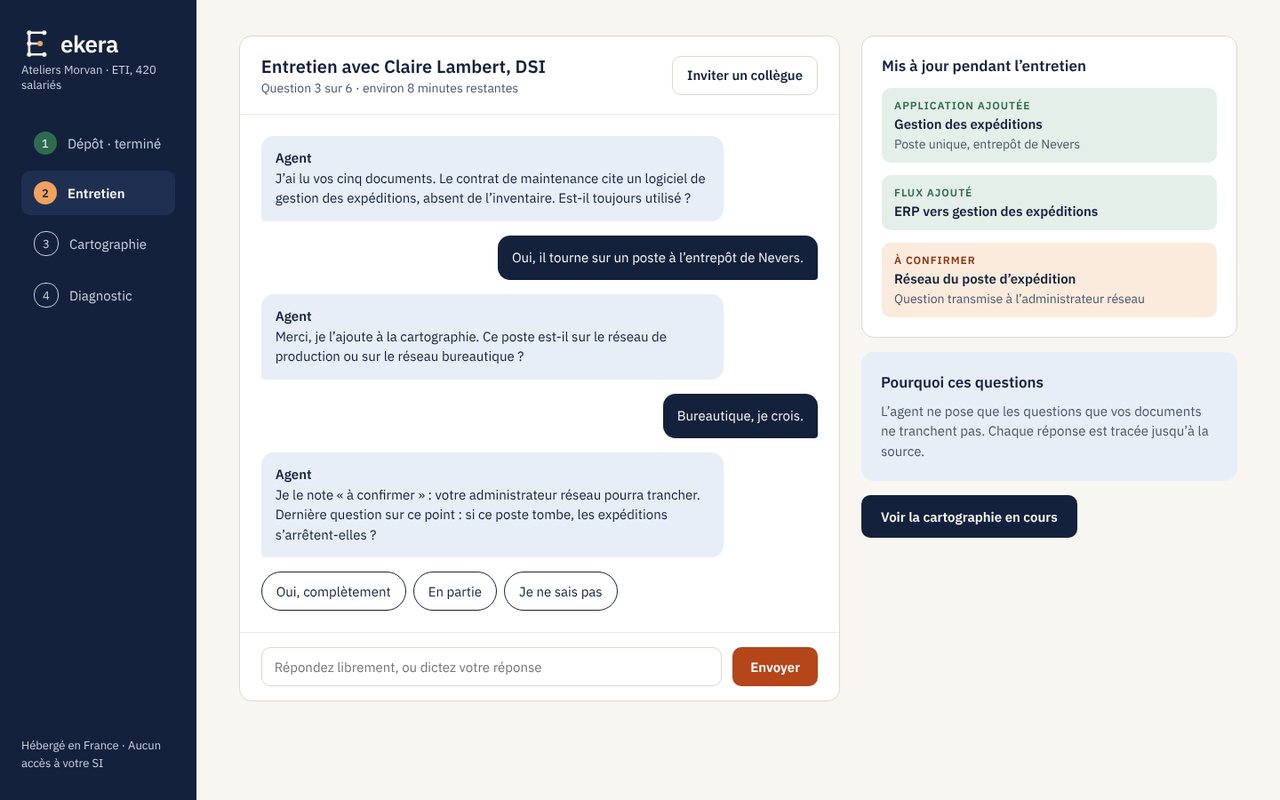
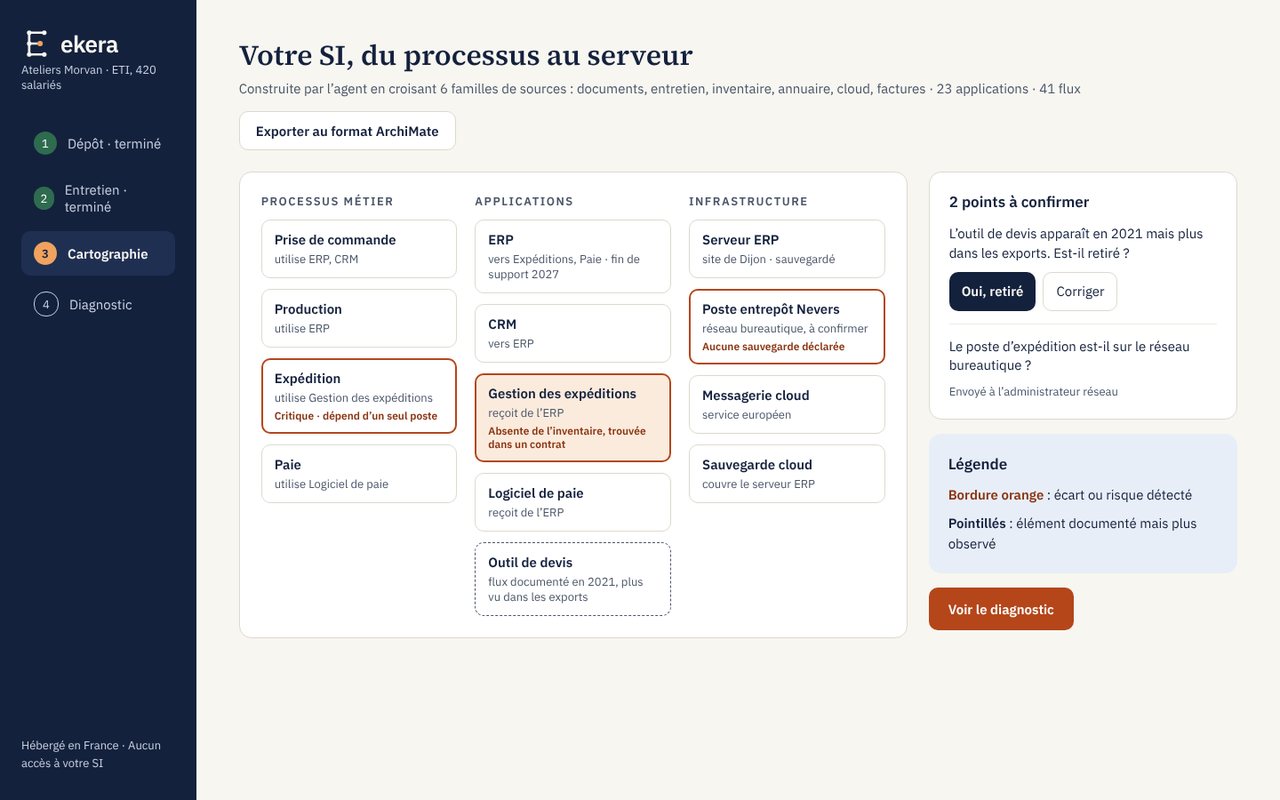
Ask your question in plain language. Every figure comes from the calculation engine, never from the language model, and every fact cites the object and the document it comes from. When the map cannot answer, Ekera says so and shows what is missing.
| Source | Status |
|---|---|
| GLPI inventory | up to date |
| Directory | up to date |
| Firewall | export older than 10 days |
| Backups | test failed: expired certificate |
| Accounting | FY 2025 |
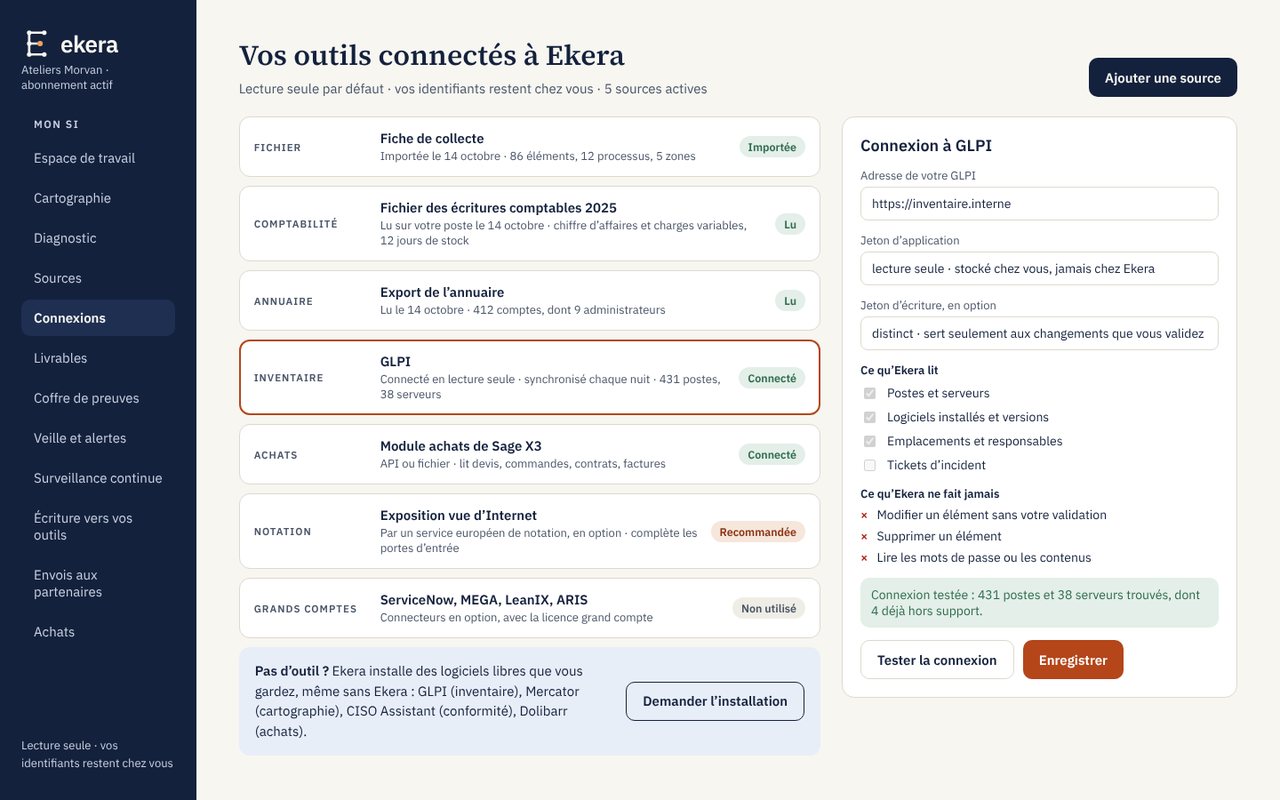
Every source shows where it comes from and what state it is in. A connection test before the first read; your credentials stay in your vault and Ekera only keeps the reference; the collector installed on your premises opens no inbound port.
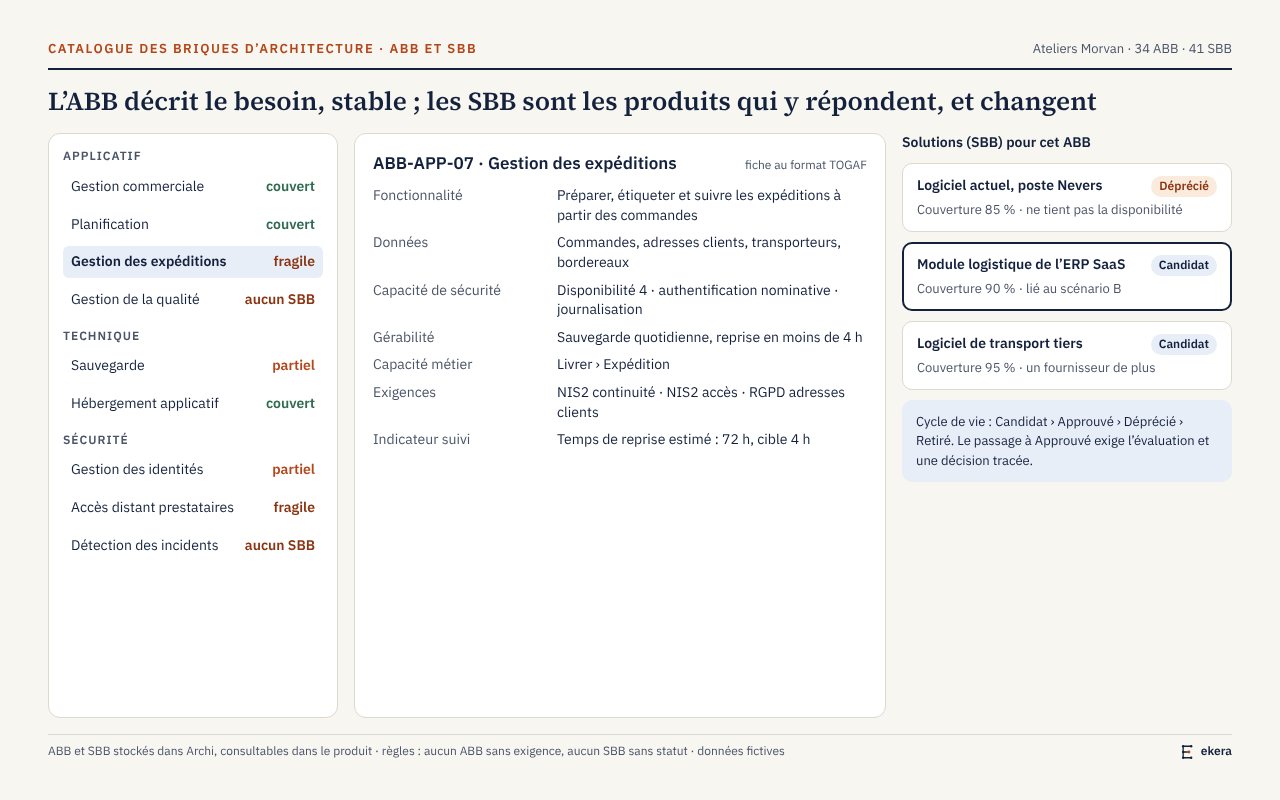
| Where to look | Option |
|---|---|
| 1. Already in house | Cloud directory, feature included in your licences, not enabled |
| 2. Approved by your purchasing team | No approved product for this need |
| 3. Market | Option A, list price · option B, qualified by ANSSI |
First, what you already have. For each need, Ekera looks at your building blocks in place, then the products approved by your purchasing team, then the market, with prices recorded and dated, or “on quote”. Feedback at 3, 6 and 12 months shows what the building block really cost.
| Document | Status |
|---|---|
| ERP technical architecture document, on your template | to review |
| Security accreditation file | 3 gaps flagged |
| EBIOS RM risk analysis, workshops 1 to 3 | draft |
| Architecture board file | approved, published |
Your templates, filled from the map. Technical architecture document, HLD, security accreditation file, EBIOS RM, architecture board file: Ekera fills in what the map establishes and flags what is missing; the architect reviews, approves and publishes. Approved changes flow back to your repositories.
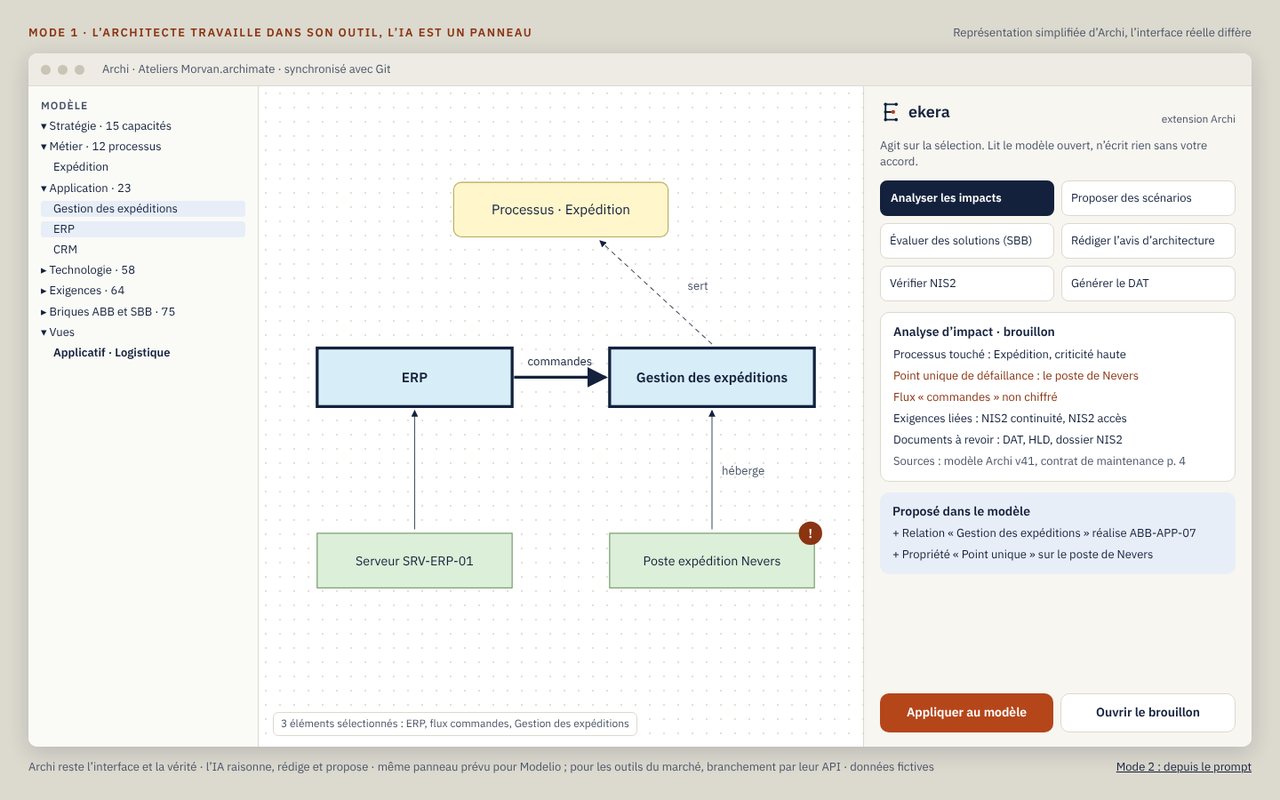
Complementary to code and infrastructure generators, not a competitor: Ekera designs and verifies, your tools or your partner IT services firm generate. Ekera never pushes code into your systems.
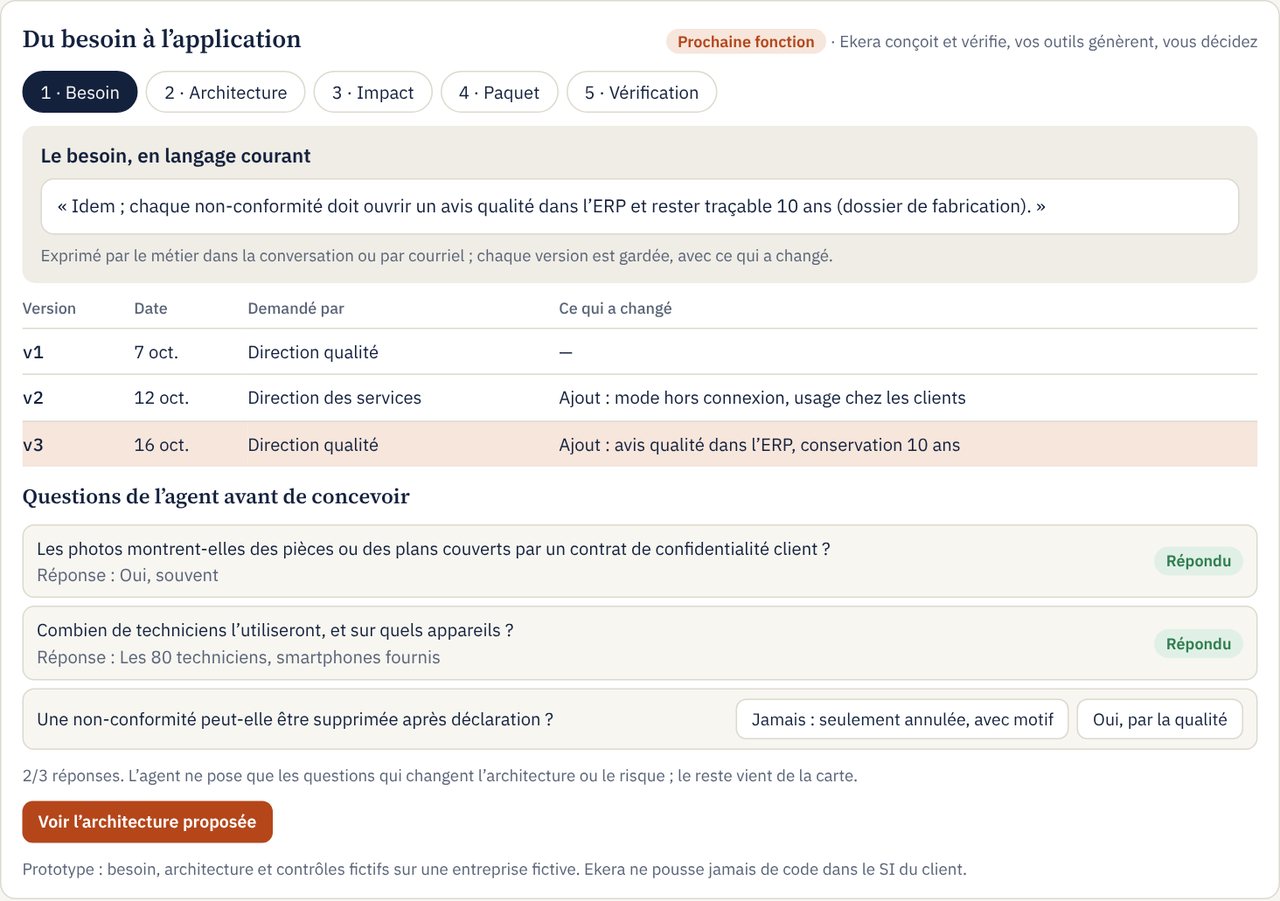
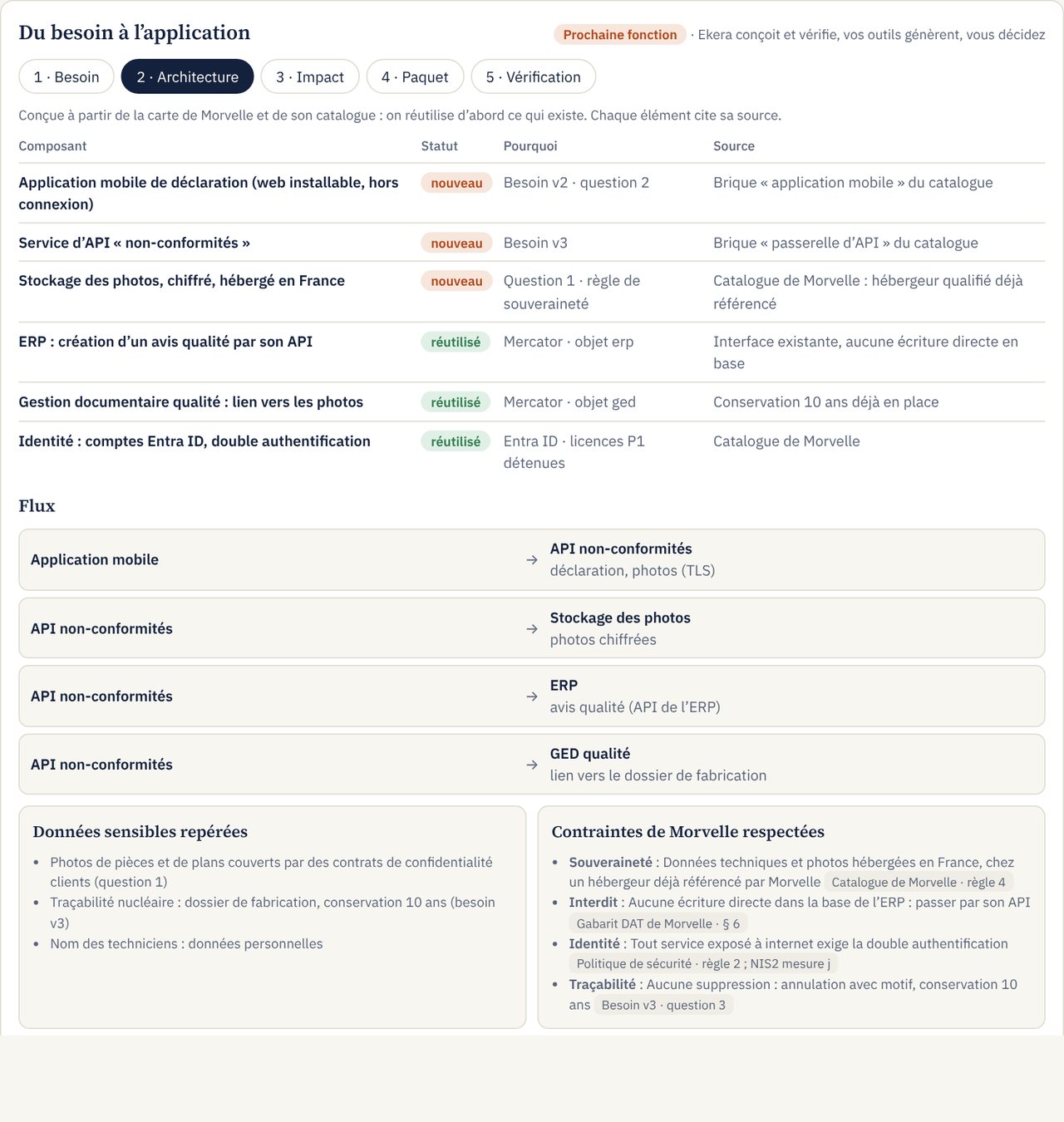
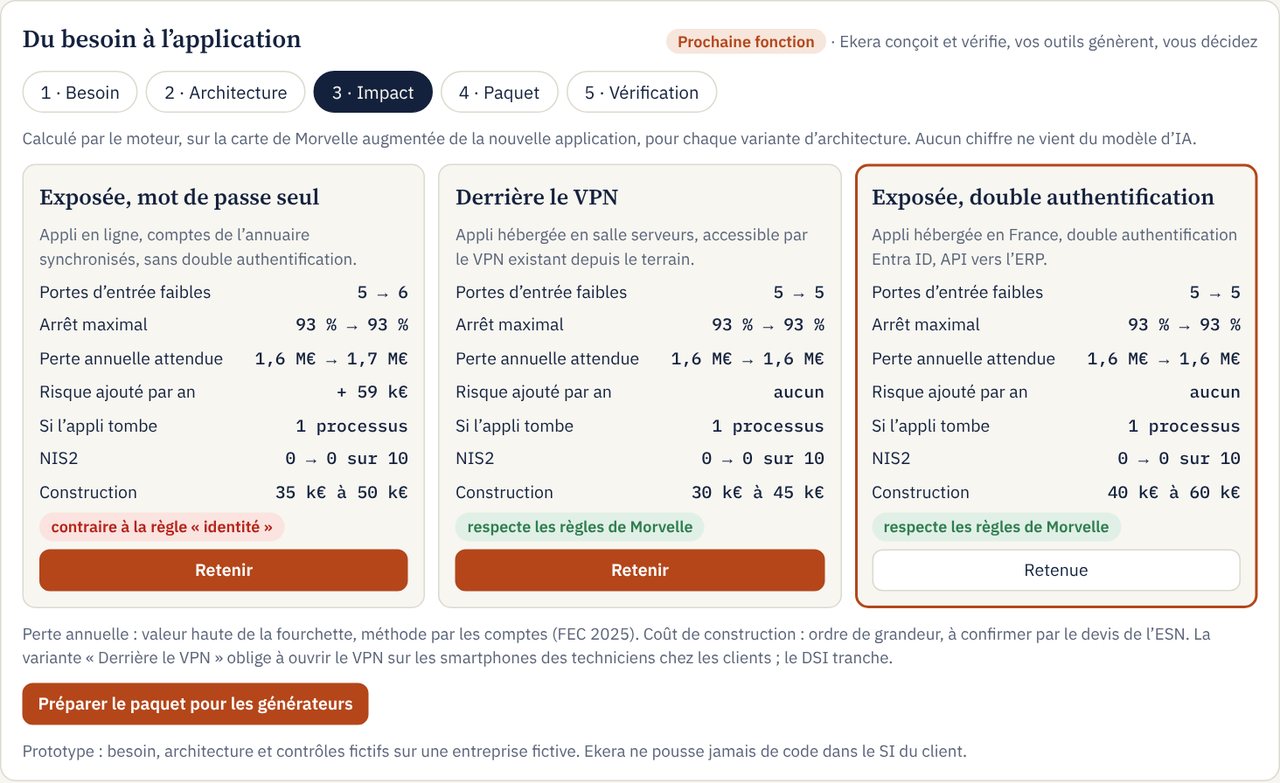
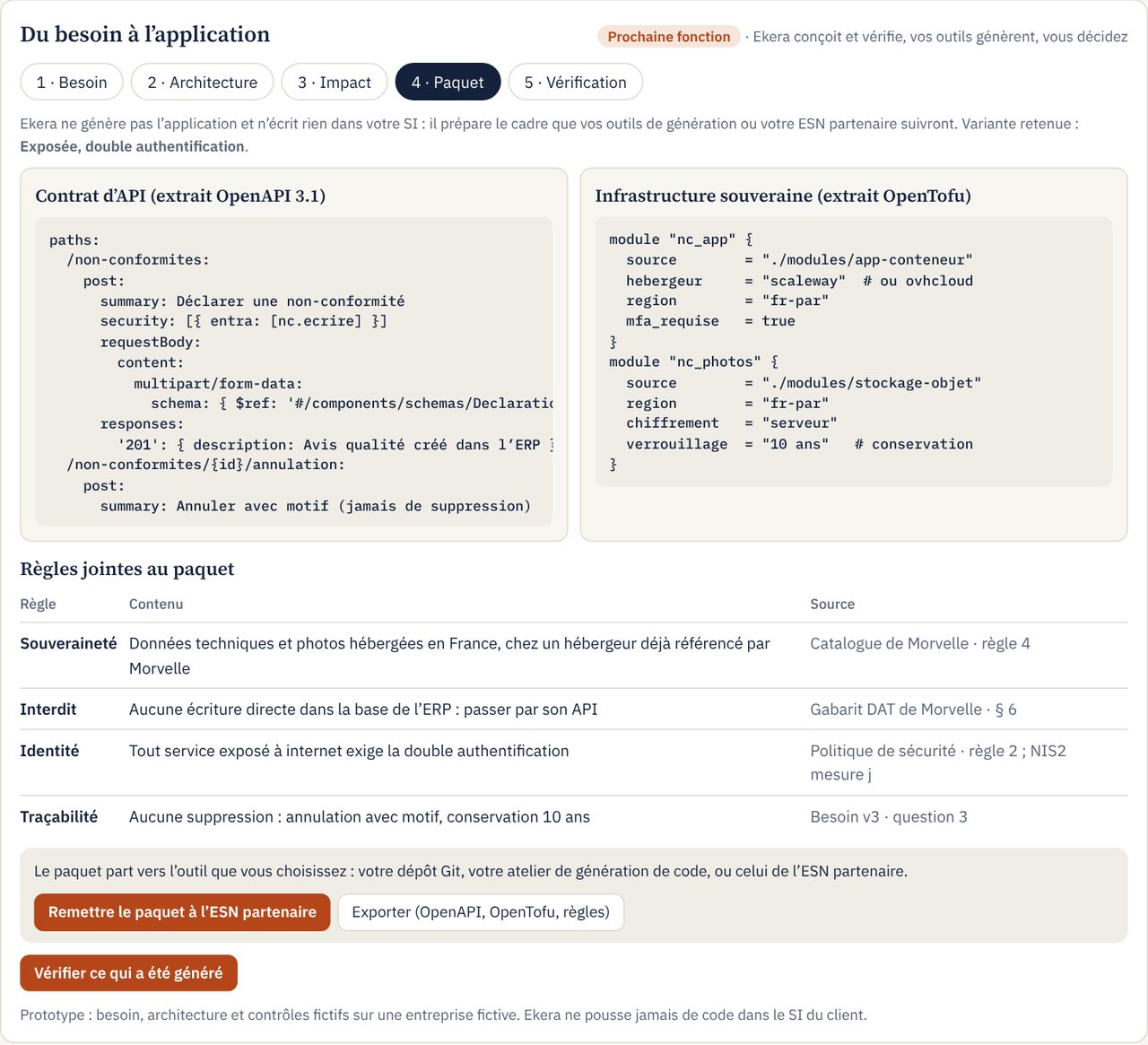
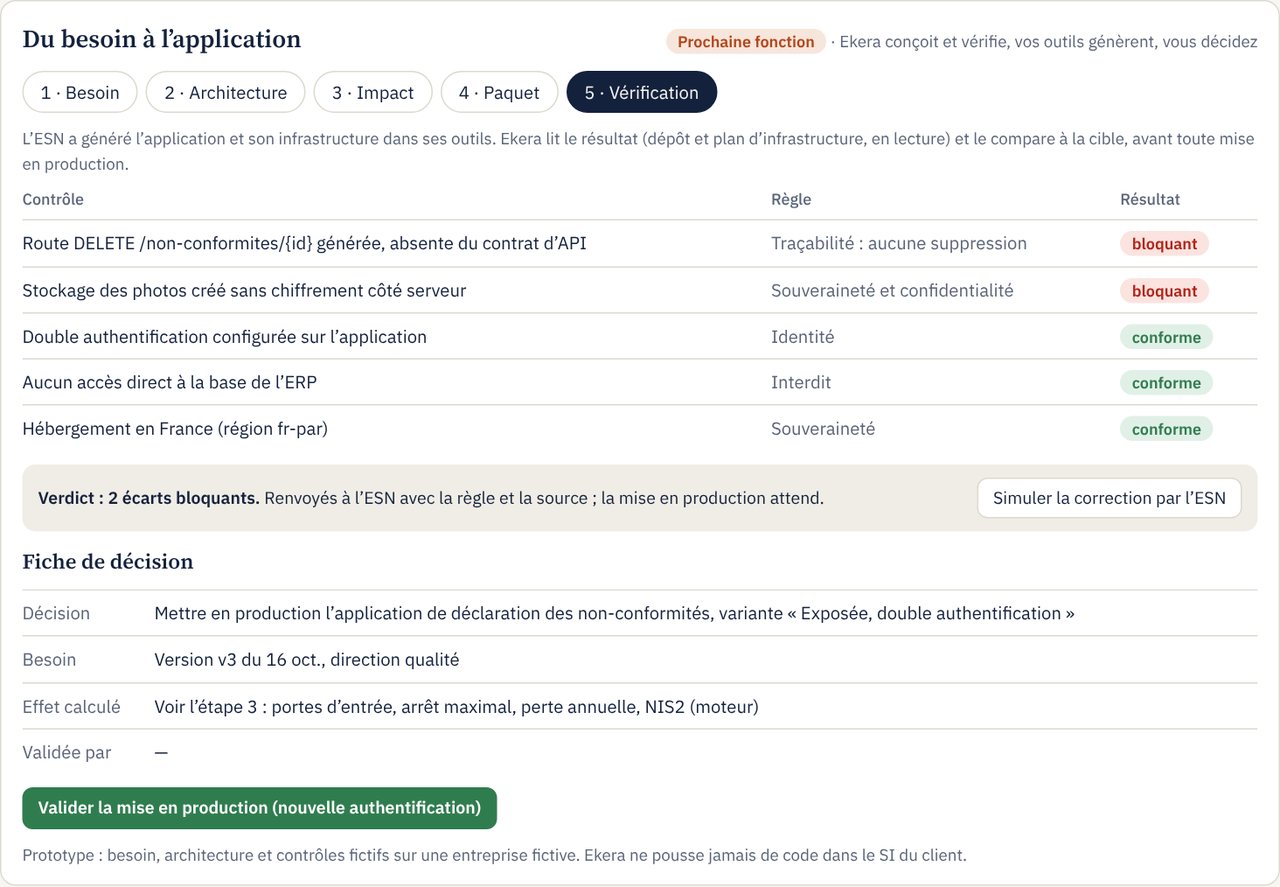
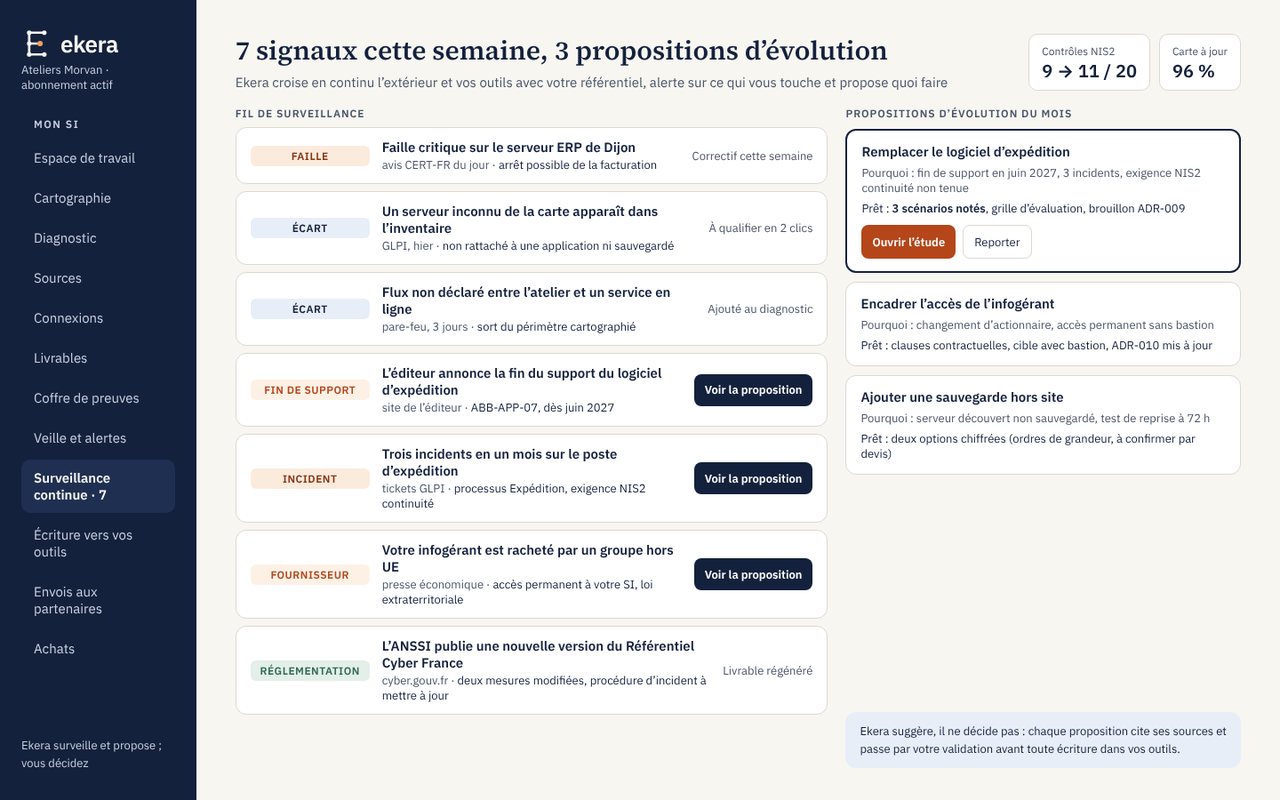
What the architect and the CISO do every week, kept up to date from the map: choosing a product, following alerts, publishing documents, keeping evidence.
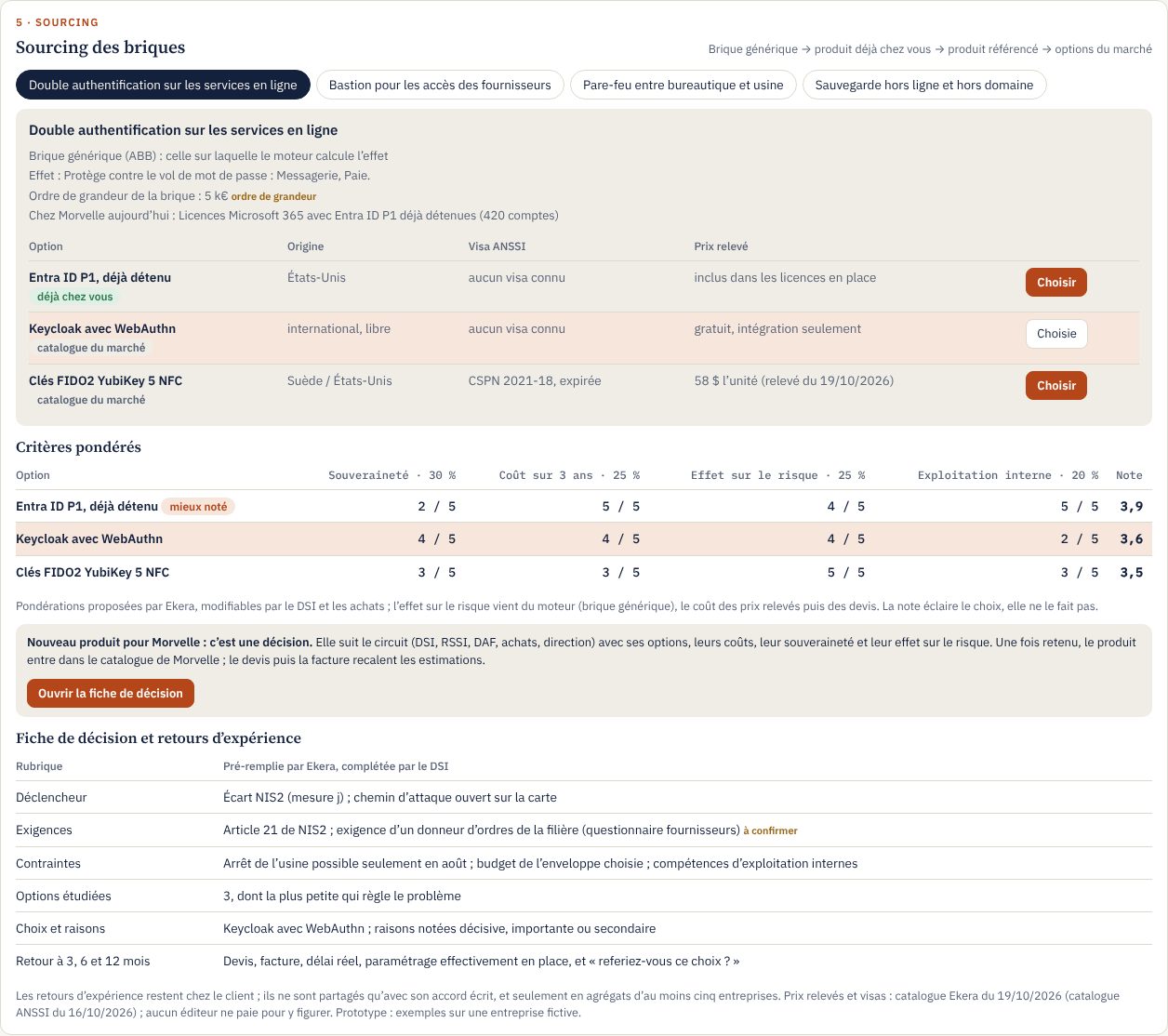
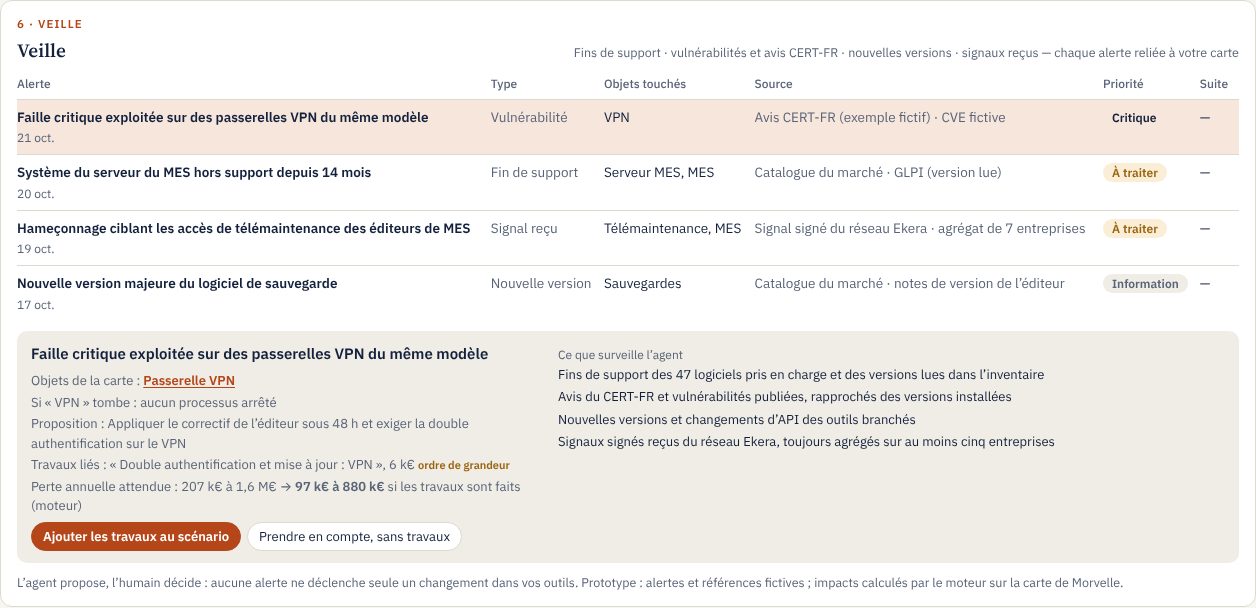
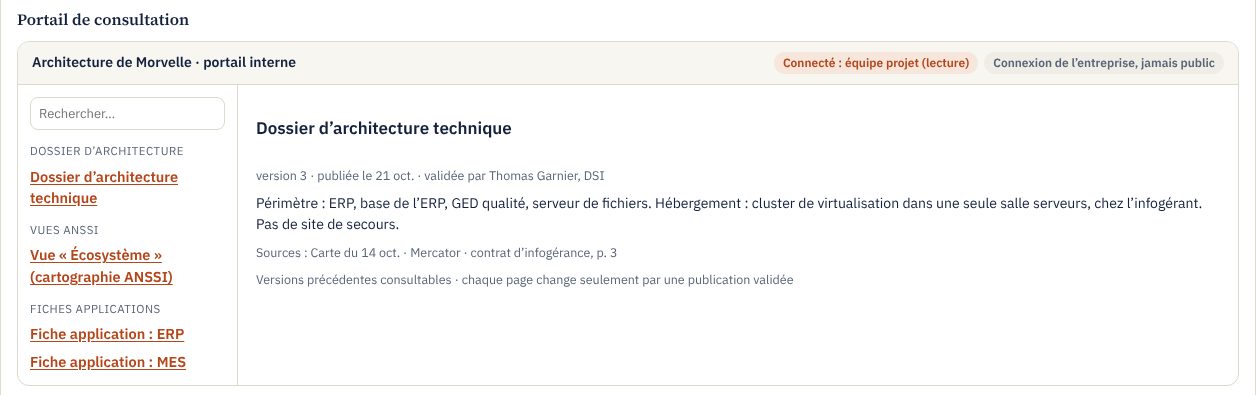
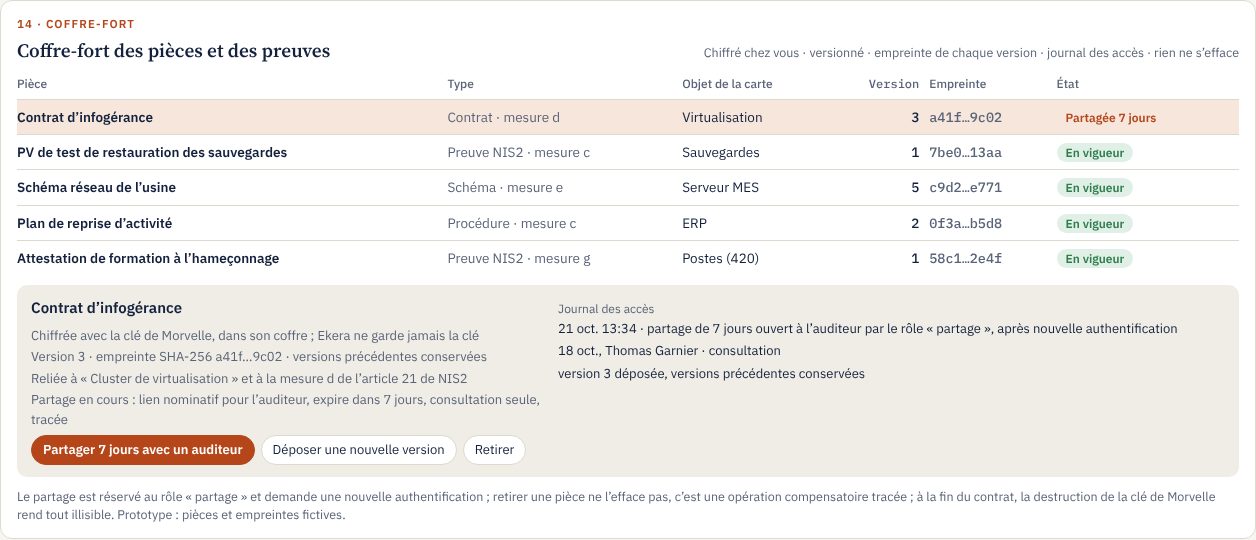
Your tools remain the reference. Ekera reads them continuously and recalculates at every change; it only writes what you have approved, and every write can be reversed. One tool is authoritative for each type of object.
| What is stored | Reference tool | What Ekera reads | What Ekera writes, after approval |
|---|---|---|---|
| Architecture views and scenarios | Archi | The model, at every save | Proposed views and relationships |
| Applications and flows | Mercator | Applications, flows, owners | Statuses, new applications, building blocks |
| Equipment | GLPI or iTop | Workstations, servers, software and versions | End of life, backups, failover |
| Network | NetBox | Zones and crossings between zones | Crossings to filter |
| Compliance | CISO Assistant | Controls and evidence | NIS2 actions, dated evidence |
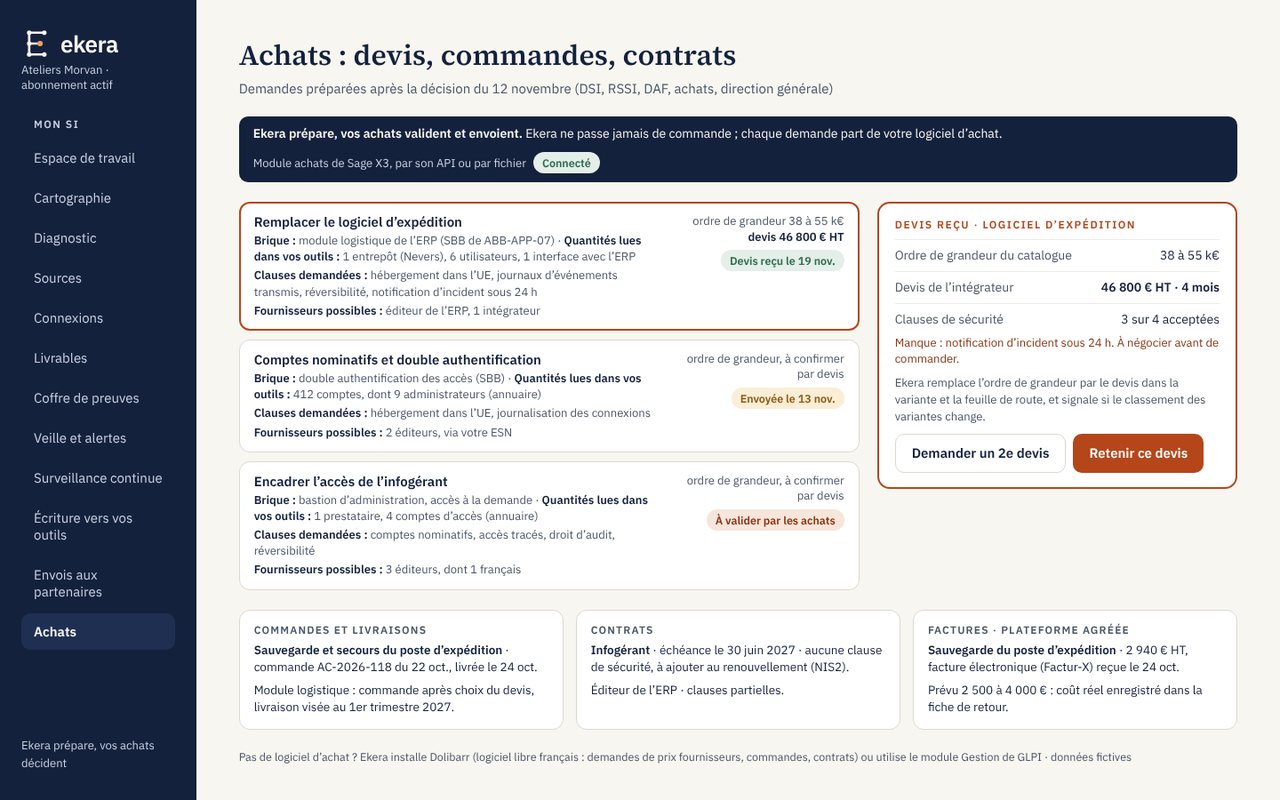
| Purchasing and suppliers | Your purchasing software | Quotes, orders, contracts, suppliers, invoices | Quote requests, approved by your purchasing team; never an order |
Do you use other open tools, such as MONARC for risk analysis? Ekera can connect to them on request.
The connector is written in a few hours from the vendor’s documentation, then tested on your premises before it reads anything.
Ekera never places an order.
Your purchasing software is usually the purchasing module of your ERP (Sage X3, Divalto, Cegid, Microsoft Dynamics 365, SAP) or a procurement suite (Ivalua, Coupa, SAP Ariba). Without a purchasing tool: Dolibarr, French open-source software, or the GLPI Management module.
A three-level catalogue, sourcing that starts with what you already have, and every new product decided by you, in writing.
ABBs state what is needed (“remote access with two-factor authentication”), SBBs state with which solution and at what cost. Each building block is linked to security measures, NIS2 controls and the calculation: putting it in place changes the euros. A monitoring agent proposes updates (end of support, vulnerability, price); an Ekera architect approves them before publication.
Each building block put in place produces a feedback record: planned and actual cost and lead time, difficulties met, observed effect. Anonymised and aggregated, with each customer’s written consent, these records will make estimates more accurate for the next customers: everyone benefits from the others’ experience.
ABBs, common to all customers: “backup out of reach”, “controlled supplier access”. Each is linked to the NIS2 measures and to the calculation.
Products, list prices recorded and dated, lead times, ANSSI qualifications. When the price is not public, Ekera writes “on quote” rather than inventing a figure.
What is already in place in your company, the products your purchasing team has approved, your negotiated prices and your actual lead times. This catalogue belongs to you alone.
Actual cost and lead time, difficulties met, observed effect on the calculation. Your feedback first enriches your own catalogue. It only serves other customers anonymised, aggregated over at least five companies, and with your written consent.
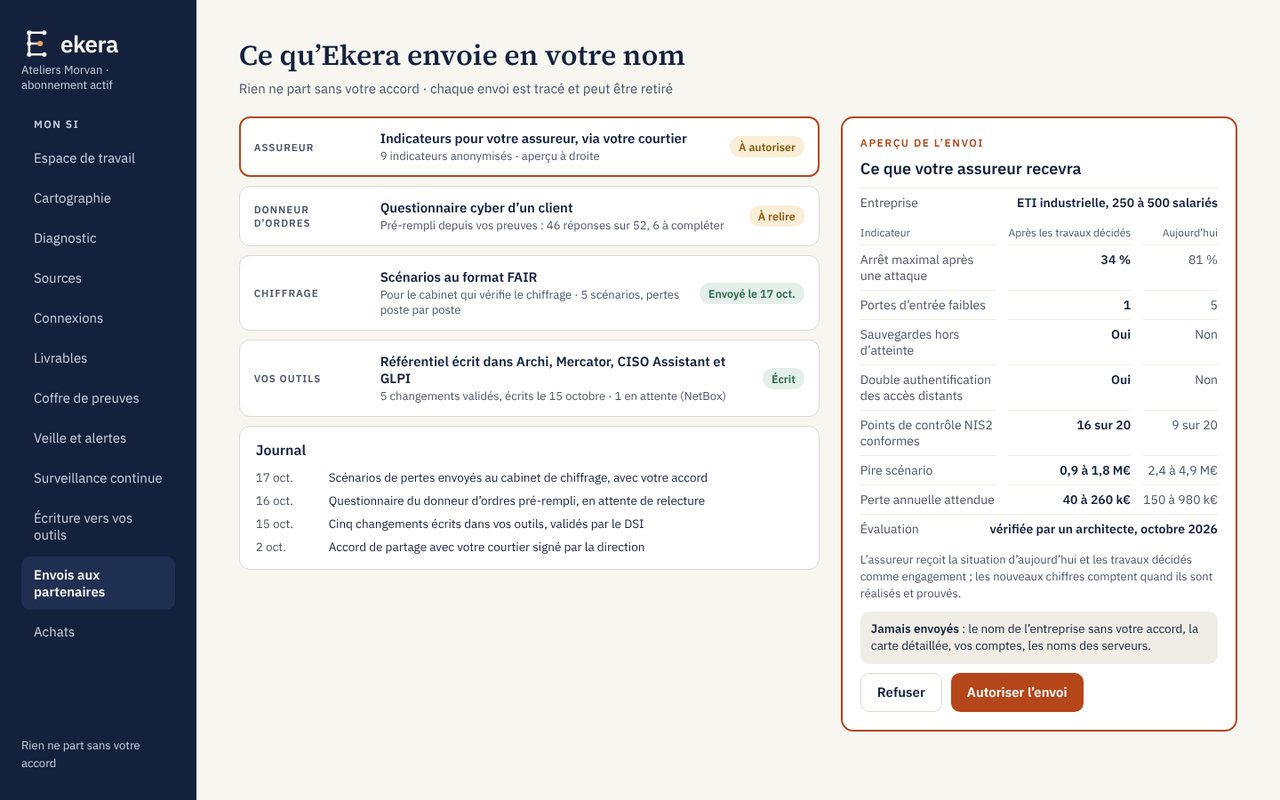
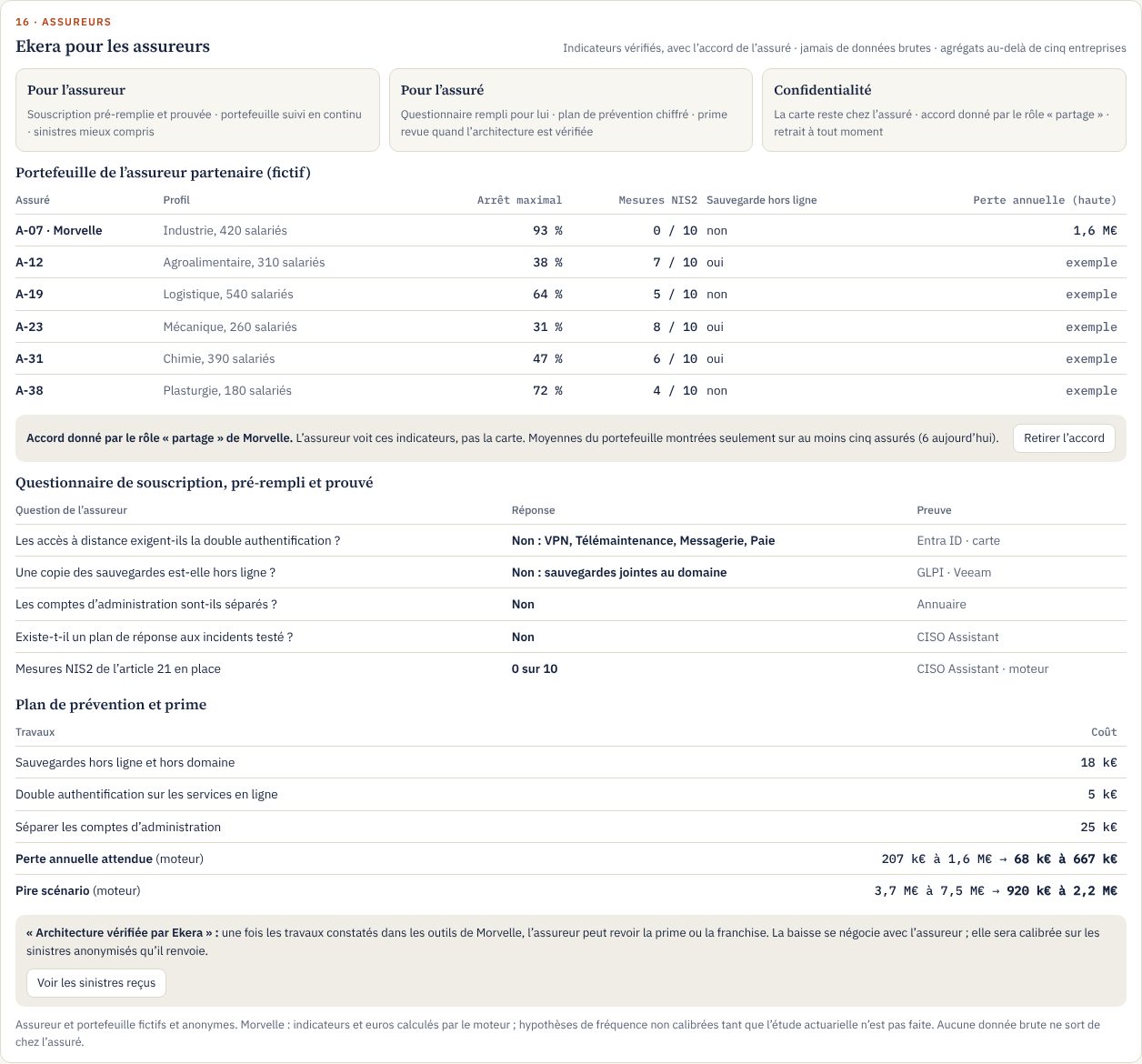
With your consent, Ekera sends your insurer or broker verified indicators: maximum outage after an attack, backups out of reach, two-factor authentication on remote access, NIS2 compliance, worst case in euros compared with your coverage limit.
Questionnaires from your insurers and from your key customers are pre-filled from the assessment; you review them before anything is sent.
With a partner insurer, the exchange will go both ways: its claims, anonymised, will be translated into Ekera’s ontology using public classifications of incidents and attack techniques (VERIS, MITRE ATT&CK), then validated by an architect and an actuary. We will see which processes, applications and building blocks they affect, and the calculation will become sharper.
This partnership is in preparation. The long-term goal: a premium that reflects your architecture.
The same cross-check of directory, inventory and contracts spots unused licences: disabled accounts that keep a licence, software installed but never opened. Every line cites its source; you decide what is returned.
AI attacks alone. With Ekera, you defend together.
With customers’ consent and in aggregates of at least five companies, every assessment enriches the lessons learned that benefit everyone.
Roughly 100 to 500 employees, industry first. The CIO does everything, often alone: Ekera brings the architecture and security team they lack.
Roughly 500 to 1,000 employees. The CISO has the responsibility without the team: Ekera does the architecture work and feeds their steering tools, without replacing them.
For architecture teams: building-block catalogue, scored scenarios and a panel inside Archi, with an annual licence. Before an acquisition: an IT due diligence in ten days, with no access to the target’s systems.
IT services firms and managed service providers: deliver assessments to your clients under your brand or ours, for a fee per assessment, and carry out the work they decide on.
Chartered accountants: your clients’ cyber risk, priced from their accounts, to advise them on their investments and their insurance.
Insurers and brokers: verified indicators on your policyholders’ architecture, with their consent.
Become a partner“Mid-sized companies have the same obligations as large groups, without their architecture teams. Ekera gives them that architect.”
Prices excluding VAT, indicative.
Large groups: annual licence, about €40,000 excl. VAT. The cost of the work proposed by the assessment depends on your suppliers: Ekera gives an order of magnitude, then your quotes replace it.
We set aside at least 30% of every subscription for Ekera’s research, quality and security. This budget is shared by all customers: every flaw fixed, every reading error removed, every new trap tested benefits everyone. The more customers, the better each one is protected, at no extra cost.
| Customers | Shared annual budget | What it funds |
|---|---|---|
| 10 | about €17,000 | A test bench of hundreds of fictitious companies and trap worlds, one penetration test a year |
| 50 | about €85,000 | Plus: an annual audit by a PASSI-qualified provider, quarterly penetration tests, human-written test worlds |
| 200 | about €340,000 | Plus: ISO 27001 certification, a bug bounty programme, full attack exercises, dedicated engineers |
| 1,000 | about €1.7M | A security and quality team, SecNumCloud-qualified hosting, a continuous testing lab |
Orders of magnitude, based on indicative subscription tiers (from €290 to about €1,200 excl. VAT per month depending on IS size): each customer contributes about €1,700 a year. The audits, certifications and hosting listed are funded as the customer base allows; they are planned, not yet carried out. With each customer’s consent and only in aggregate, from five companies, lessons learned also improve Ekera for everyone. Our R&D.
By sharing what they learn, our customers benefit from the vigilance of a large group without its teams. It works like a community navigation app: every driver who reports a traffic jam helps all the others. At Ekera, when a customer spots an attack, an exploited flaw or an incident, the signal benefits everyone, and each receives the alerts and protections drawn from the others’ experience.
The difference that matters to a CISO: our signals cannot be poisoned. Each signal is checked by two people at the customer, then by an Ekera analyst, and signed. It is shared only with the customer’s consent, given by a designated person, and only in aggregate, from five companies. No raw data leaves your premises. Signal analysis is funded by the shared 30% budget.
Security plays out on three levels. AI accuracy: Ekera’s strength, tested on a bench of hundreds of fictitious companies, as in an AI lab. Security of the Ekera product: secure development already in place (code review by a dedicated role, automated analysis, secret scanning, verified dependencies, bypass tests, independent review), then an outside view planned and funded by the shared budget: a penetration test by a provider, a PASSI audit, certification. Security of your systems: Ekera does not run penetration tests and never enters your network. It reads, read-only, and computes what an attack would stop without launching it. PASSI-qualified providers remain essential, and become our partners.
Ekera does not replace penetration testing: it targets it. It tells you what to test first, the attack paths and single points of failure that matter, and what an outage would cost; you avoid paying to test what has no impact. The provider’s findings flow back into the map and the costing in euros, with the work to be done, and Ekera monitors continuously between two annual campaigns. The result: shorter or more useful penetration tests, and monitoring the rest of the year.
As a rule, yes if you are a medium or large company (at least 50 employees or more than €10M in revenue) in one of the 18 sectors covered: energy, transport, health, water, digital, manufacturing, food, waste, postal services, chemicals, among others. In France, the transposition law has not been passed yet: adopted by the Senate in March 2025, it is still awaiting the National Assembly, and the Court of Justice of the European Union has been seized against France in July 2026 over the delay. The obligations will apply once the law and its decrees are adopted. The directive provides for fines of up to €10M or 2% of worldwide turnover for essential entities, and €7M or 1.4% for important entities. Your customers, insurers and buyers often ask the same questions today, even if you are not directly covered.
It is hosted in France and segregated per customer: separate database, encryption keys, indexes and backups. Ekera uses open AI models hosted in France: no data goes to US services. For sensitive sites, the AI can run on your premises.
No. You upload documents and exports, or plug in read-only connectors. To write the changes you approve, Ekera uses separate, optional access limited to those changes, with no administrator rights.
From your accounts. The accounting entries file, which every company in France can produce, gives revenue and variable costs; it is read on your computer. The assumptions (outage duration, share recovered, penalties) are shown and can be discussed with your CFO or your accountant.
At first it is an order of magnitude, flagged as such. It becomes the list price multiplied by your quantities, or a sourced and dated range when the price is only available on quote; then your suppliers’ quote, requested by your purchasing team from your purchasing software once the work is decided; then the actual cost read from the invoice. Ekera never places an order.
An audit tests your defences. Ekera maps what you have, calculates what an attack would stop, measures the gaps against requirements and prepares the evidence. The two complement each other: Ekera’s map and evidence make your auditor’s work easier.
Those tools help a CISO track risks and frameworks, based on what is declared in them. To our knowledge, they do not calculate on the map of your systems what an attack would stop, and they do not propose the target architecture with its cost. Ekera can feed the tool you already have.
No. Ekera does the architecture work and the calculation; it does not carry responsibility for your security and does not keep your books. It gives your CIO, your CISO if you have one and your accountant costed, sourced material to decide.
The figures come from a calculation engine, not from the AI. Every finding cites its source, which you can check. When the agent is unsure, it says so and an expert checks. You confirm the facts you know before the map is written into your tools.
You keep the map and the deliverables. With the subscription, Ekera keeps the map up to date from your tools, monitors the vulnerabilities and end-of-support dates that concern you, and proposes the changes to decide on every month.
Our first customers get a launch offer for their first assessment, on preferential terms. A 30-minute call is enough to see whether Ekera is right for you.
contact@ekera.ai