Map your IT. Price your risks. Decide what to fix.

Know where your information system is vulnerable, what an incident could cost and which investments to prioritise.

  • Understand: mapping and critical dependencies.
  • Price: risk scenarios and financial consequences.
  • Decide: measures prioritised by cost and expected effect.

Ekera links your applications, your infrastructure and your business activities to identify critical dependencies, estimate the financial consequences of an attack or an outage and compare corrective measures by cost and expected effect.

You get a documented map, costed risk scenarios and a roadmap to inform your decisions.

AI automates part of the analysis and documentation. Facts are linked to their sources, assumptions are explicit and your teams stay in control of the decisions.

Request an Ekera assessment

Initial assessment from your documents and exports, with no direct access to your information system. Open AI models, hosted in France.

See the demo
Demo · Ateliers Morvan, fictitious example

What could an attack on your information system cost?

A technical vulnerability does not, on its own, tell you which activities would be interrupted or what it would cost. Ekera links applications, infrastructure and business processes to answer three questions. Ateliers Morvan is a fictitious example: its figures illustrate how the engine works.

Assessment Ateliers Morvan · fictitious example
81% of critical activity stopped in the worst attack scenario
IndicatorBaselineAfter the work (simulation)
Maximum outage after an attack81%34%
Worst case€2.4M to €4.9M€0.9M to €1.8M
Expected annual loss€150k to €980k€40k to €260k
Weak entry points51
Backups out of reachnoyes
NIS2 measures assessed as met4.5 of 108 of 10
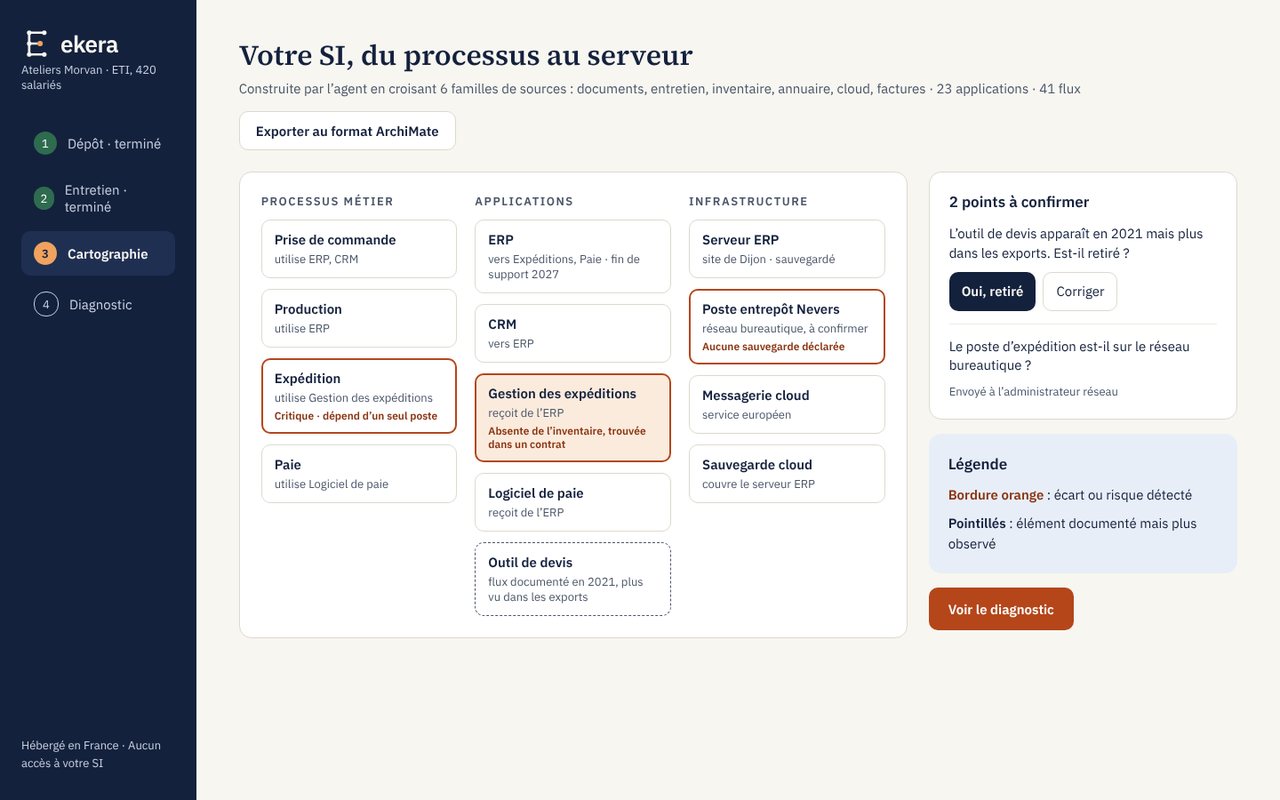
Single point of failure: the shipping workstation in Nevers. Dependency: maintenance contract, p. 4; no backup: backup report of 3 October.
Fictitious example · amounts: estimated potential losses, conditional on the assumptions used · “after the work”: conditional estimates, not guaranteed risk reductions · NIS2 score: a progress indicator on the measures assessed, not a compliance certification
1 · Where is the risk?

81% of critical activity stopped

The share of critical activities that the worst attack scenario would stop. Single point of failure: the shipping workstation in Nevers.

How it is calculated

Sum of the criticality of the business processes stopped in the worst attack scenario, divided by that of all modelled processes. A process counts as stopped as soon as a component it depends on is reached; the engine does not distinguish processes that are merely degraded. Example: shipping depends on a single workstation in Nevers; the dependency comes from the maintenance contract, the missing backup from the backup report, each with its date.
2 · What could the financial impact be?

€2.4M to €4.9M in the worst case

Expected annual loss: €150k to €980k. The estimates depend on the scenarios chosen, the data available and the calculation assumptions.

How it is calculated

The expected annual loss adds up, for each entry point and each single point of failure, estimated annual frequency × scenario loss. The range runs from low assumptions (frequencies, days of downtime, response costs) to high ones. The worst scenario is the loss from the costliest entry point.

3 · Which work should be funded?

Measures compared, for three budgets

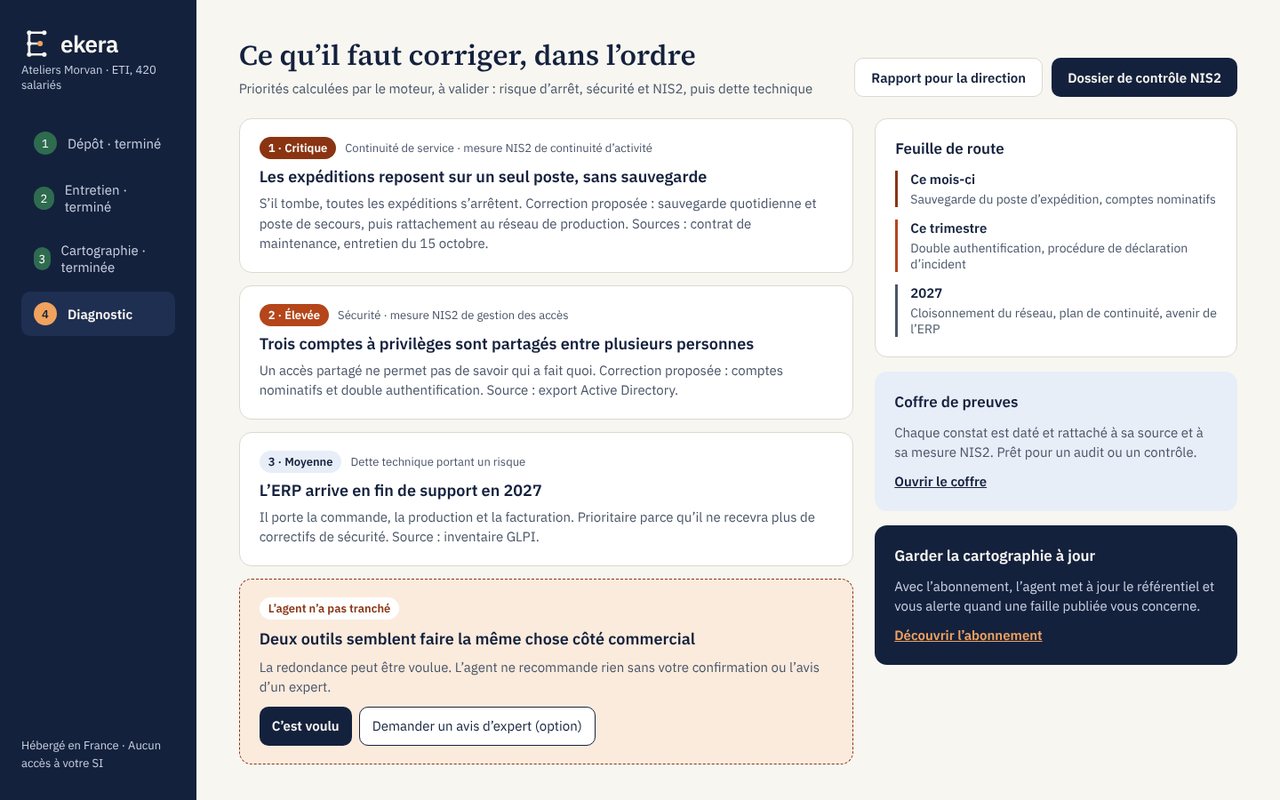
The engine compares combinations of measures from its catalogue by cost and estimated effect on risk. After the work (simulation), the maximum outage would fall from 81% to 34%; your teams judge feasibility and approve the measures.

Conditions and NIS2 score

The “after the work” results assume these measures are carried out and produce the modelled effects: they are conditional estimates. Costs are orders of magnitude, to be confirmed by quotes. The NIS2 score counts the ten Article 21 measures: 1 point per measure met, ½ if partial; it is a progress indicator on the measures assessed, not a compliance certification.

See what this analysis would show for your company.

Request an Ekera assessmentSee the demo (in French)

Download a report extract (fictitious example, PDF) Five pages: summary, critical dependency, costed scenario, work options, roadmap.

The indicators depend on the data available, the assumptions made and the scope analysed.

The offer · Ekera Assessment

The Ekera Assessment: four deliverables to decide what to fix

A single entry offer, from €3,500 excl. VAT, subject to validation of the scope. The assessment works from your documents and exports, with no direct access to your information system. The scope, the data needed and the deliverables are defined with you before starting.

Deliverable 1

A documented map of your IT

On the agreed scope: business processes, applications, flows, infrastructure and suppliers, each item linked to its source. What is missing or contradictory is flagged.

Deliverable 2

The critical dependencies and the scenarios studied

Single points of failure, weak entry points, attack and outage scenarios, verifiable in the sources; the gaps against the ten Article 21 measures of NIS2.

Deliverable 3

A financial estimate of the risk

Worst case, expected annual loss and the cost of a given scenario, as ranges, calculated by an engine independent of the language model, with their assumptions.

Deliverable 4

A prioritised roadmap

Measures compared by cost and estimated effect, with several budget variants; costs are orders of magnitude, to be confirmed by quotes.

The assessment, applied to your scope.

Request an Ekera assessment

Download a report extract (fictitious example, PDF) The four deliverables, on Ateliers Morvan, a fictitious company.

The NIS2 score is not a compliance certificate. “After work” results are conditional estimates, not guaranteed risk reductions. See pricing.

How it runs

How an Ekera Assessment runs

A few days of work, starting from what you already have. Your teams are only asked about what the documents cannot establish.

  1. 1 · First call Scoping In 30 minutes: your need, the possible scope and the information required for the assessment.
  2. 2 · Documents What you have Diagrams, contracts, inventories, exports from your directory, firewall, tickets or purchasing. No direct access to your IT, no admin rights.
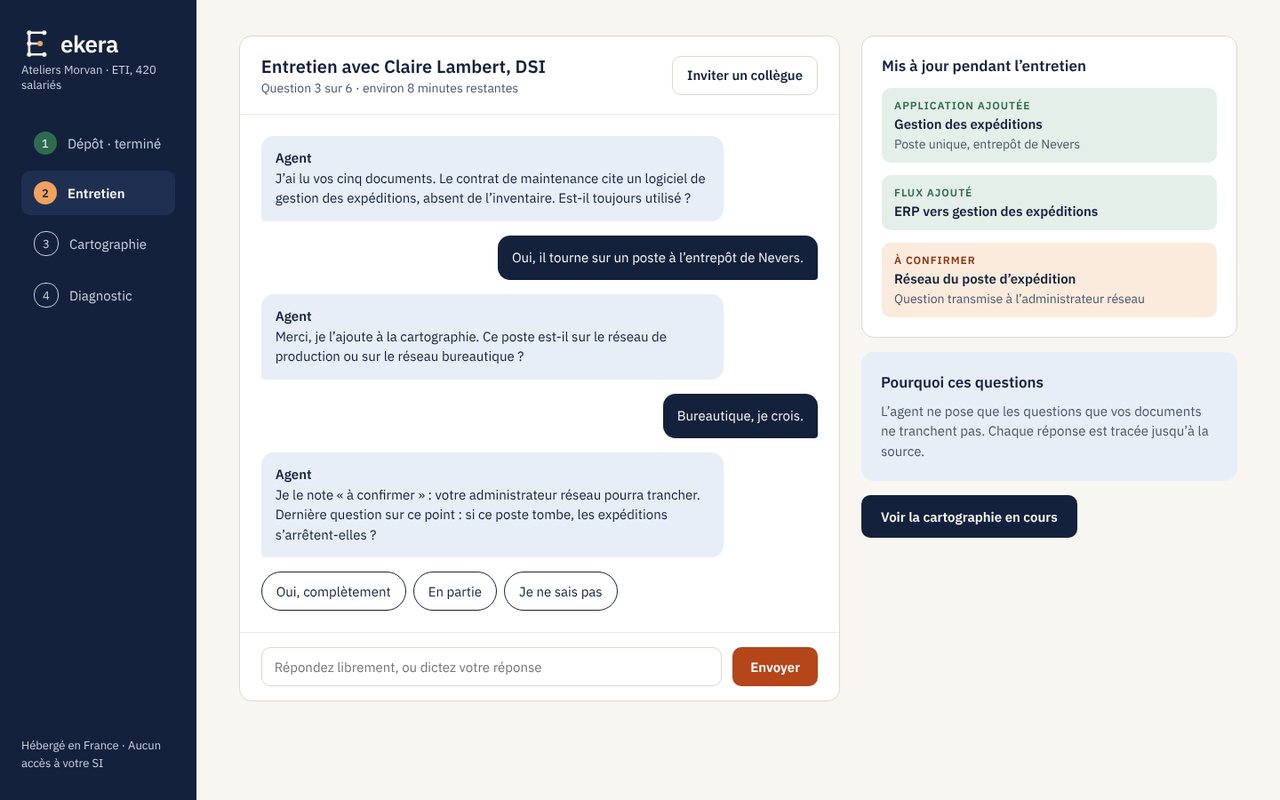
  3. 3 · Interview The useful questions The agent asks your teams, online and at your pace, only about what changes the map, the risk or the decision.
  4. 4 · Analysis Map, scenarios, euros The map is built, the critical dependencies identified, the scenarios costed by the calculation engine; the assumptions are displayed.
  5. 5 · Delivery The four deliverables The CIO reviews the dependencies, the CISO the risks, the CFO the costs; management decides.

Then, if you decide: continuous monitoring, from €290 excl. VAT a month, keeps the map up to date and follows the measures decided, with their evidence.

Video demo

Watch Ekera in 3 minutes

Morvelle Industrie, a fictitious manufacturer: the map of its information system read from 17 documents, what an attack would stop, what it would cost according to the calculation engine, and three proposed investment scenarios for the company to validate. Subtitles in French.

Fictitious case: company, documents and figures are invented. Estimated potential losses, provisional calibration.

See the online assessment too, on video

Security and sovereignty

Ekera’s security, up to what it analyses

A tool that reads your information system’s dependencies must offer safeguards matching the data it handles. Ekera separates what is in place from what is planned.

Control of data Open-weight models served in France; no customer data sent to US services; hosted in France. For sensitive sites, the AI runs on your premises.
Access control Rights set by use, read-only by default; connections and writes limited to the scope agreed with you.
Traceability Operations are recorded: who approved, when, what changed. Tracing or undoing a change is separate from data retention and deletion.
Human approval Ekera prepares analyses and recommendations; decisions and changes go through your approval flows. Nothing is written into your tools without your consent.
Calculated, not declared The figures come from a calculation engine, not the language model; every finding cites its source.
No lock-in Your data stay in open tools and formats. If you leave, everything stays with you.
What we do to stay secure

Large-company security, for a mid-sized company

Ekera brings a mid-sized company the security resources of a large group, shared among its customers. A tool that reads the map of your systems must itself meet the standards of a large group. Here is what is in place today, at the level of principle.

Your data

  • Open-weight models served in France
  • Each customer isolated at several levels, tested by cross-access attempts
  • Every change is traced and can be compensated by a reverse operation

Access and writes

  • Identity from your own directory; separate roles, including one dedicated to sharing
  • Read-only by default; writes signed, single-use, recalculated by Ekera
  • Collector with no inbound door; documents analysed in an isolated space

Development and website

  • Review by a dedicated security role, independent review
  • Code analysis, secrets searched across the full history, locked dependencies, licence checks, tests that replay every known bypass
  • Website checked before any publication, no third party loaded

Also in place: hosted in France, one encryption key per customer and erasure by destroying the key at the end of the contract, fresh authentication before every write approval. Planned: external penetration test, PASSI audit, bug bounty, ISO 27001, SecNumCloud-qualified hosting. These tests cover Ekera itself: Ekera does not certify your architecture and does not replace your penetration tests; it targets them and tracks your exposure between two campaigns. Read the security documentation.

Get the security sheetSent after a first conversation.

The founder

An approach rooted in enterprise architecture

Ekera grew out of a field observation: companies must make complex decisions about their information systems, often without the analysis and documentation resources of large groups. The project draws on experience in engineering, solution architecture and enterprise architecture in demanding, regulated environments. The ambition: make part of this work accessible through AI, while keeping traceability, human approval and control of decisions.

“Mid-sized companies have the same obligations as large groups, without their architecture teams. Ekera brings them that architect’s work; they keep the decisions.”

Frequently asked questions

Your questions before a first assessment

Do we have to give Ekera access to our information system?

Not for the initial assessment: it works from your documents and exports, with no direct access to your IT and no admin rights. To keep the map up to date, read-only connectors or a collector installed on your premises can be used afterwards, on terms agreed with your IT team.

Where do the euro figures come from?

From a calculation engine independent of the language model, which applies explicit rules to your data, including accounting data, and to displayed assumptions. They are estimates given as ranges, to discuss with your teams, not a guarantee of the actual cost of a future incident.

Is the NIS2 assessment a certification?

No. Ekera identifies the gaps against the ten Article 21 measures, organises the evidence and prepares a roadmap; it issues neither a certification nor a compliance certificate.

Does Ekera change our tools?

Only what you have decided, after approval by an authorised person and through the process agreed with you. Every write is logged, and Ekera never deletes anything.

Where is our data processed?

The AI models are open-weight models served in France; no customer data is sent to American services. Hosted in France.

Does Ekera lower the cyber insurance premium?

Ekera does not promise a lower premium. With your consent, it sends documented indicators to your insurer or broker; pricing and cover terms remain the insurer’s responsibility.

How much does a first assessment cost?

From €3,500 excl. VAT, subject to validation of the scope, prioritisation included; continuous monitoring starts at €290 excl. VAT a month. On-site installation and support for large accounts are quoted on request.

Pricing

Start with an assessment, then follow what changes

A single entry offer: the Ekera Assessment. Continuous monitoring comes next, if you decide. The scope, the data needed and the deliverables are defined with you before starting.

The entry offer

Ekera Assessment

from €3,500 excl. VAT

Subject to validation of the scope.

Four deliverables

  1. A documented map of your IT on the agreed scope
  2. The critical dependencies and the scenarios studied
  3. A financial estimate of the risk, with its assumptions
  4. A prioritised roadmap, with several budget variants
Request an Ekera assessmentDownload a report extract (fictitious example, PDF)
Next step · Continuous monitoring
from €290 excl. VAT / month

Every month

  • The map kept up to date
  • Relevant changes flagged: connected sources, published vulnerabilities, end of support
  • The measures decided followed up, with their evidence

Monitoring starts after the assessment, when you decide.

Launch offerabout €1,500 excl. VATReserved for the first ten companies; assessment delivered within three months of the order

What is included

The Ekera Assessment and its four deliverables, on a restricted scope.

Who is eligible

  • A mid-sized company with 300 to 2,000 employees
  • One activity or site, and its applications
  • Documents and exports available

Scope limits

  • One activity or site, and the applications that support it, defined with you before starting
  • Analysis from your documents and exports, with no connection to your tools
  • Continuous monitoring not included

In return

Written feedback and a feedback interview: this is what you give in return for the launch price.

A testimonial, if any, is separate: it requires your separate consent and is never mandatory.

Request the launch offer

IT due diligence · about €12,000 excl. VAT · quality score of the IT, red flags and cost of remediation, with no direct access to the target’s systems.
Large accounts · on quotation · on-premises installation and support; annual licence for large groups’ enterprise architecture, about €40,000 excl. VAT.

Prices excluding VAT, indicative. The cost of the work proposed by the assessment depends on your suppliers: Ekera gives an order of magnitude, then your quotes replace it. Insurers and brokers: Ekera Assurance.

Request an Ekera assessment

Understand your information system before deciding what to change

Four fields are enough. The first call lasts 30 minutes; you come away with:

  • a scoping of your need;
  • the possible scope for the assessment;
  • the list of information needed for the assessment: documents and exports to gather.

See the demo

Contact address:contact@ekera.ai

Your details are only used to get back to you. No trackers on this site.

What you save · simulation

Measure the savings and productivity potential of your IT

Time freed up, better-targeted spending and better-documented decisions. Ekera reduces collection and documentation work, spots some avoidable spending, such as unused licences, and helps target investment better. Three typical cases, with Ekera’s price deducted:

Per year, as an exampleMid-sized company, 550 employeesFictitious large account, 50 architectsBank or insurer, 75 architects
Productivity: time freed up × €800 per day80 d × €800 = €64k50 × 40 d × €800 = €1.6M75 × 40 d × €800 = €2.4M
Direct savings: unused licences cancelled€62knot priced€2.55M
Avoided costs€30k in the first year (NIS2 assessment)€130k (committee time)not priced
Cost of the assessment (one-off)− €3.5kon quotationon quotation
Cost of monitoring (annual)− €3.48k− €40k− €40k
Estimated net benefit, first year≈ €149k≈ €1.69M, less the installation on quotation≈ €4.91M, less the installation on quotation
Estimated net benefit, recurring annual≈ €123k≈ €1.69M≈ €4.91M

Explicit assumption: the days recovered (80 a year for the mid-sized company, 40 per architect per year for large accounts) are typical-case assumptions, not measured. Productivity is a gain in capacity, not cash, unless it avoids spending. Ekera prices used: assessment from €3,500 excl. VAT and monitoring from €290 excl. VAT a month for the mid-sized company; annual licence for large groups, about €40,000 excl. VAT. Not counted: about €75k a year of purchases avoided through the network effect for the mid-sized company, a future potential. In gross terms, before Ekera’s price, the mid-sized typical case ranges from €63k (construction) to about €310k (banking and insurance) depending on the sector. The detail of each case.

What we do not price: the agility to evolve the IT system without waiting, technical debt, projects that slip less, audits prepared, better-targeted penetration tests, easier insurance underwriting. The full list. In France, the gross potential is about €1.9bn a year (€0.7bn to €4.2bn) if every company concerned were equipped: a potential, neither revenue nor market share. Sources: Insee, Zylo 2026, public NIS2 audit rates 2026.

Illustrative simulations: typical cases not measured at customers. Each estimate states its scope, period, the costs included and the conditions needed for the gain.

How Ekera works

AI automates part of the analysis and documentation. You stay in control of the decisions.

Ekera uses your documents, your exports and, when you decide so, data from your tools. It builds a documented map of your information system, analyses its dependencies and prepares change decisions. Results are tied to their sources; missing information, assumptions and the limits of the analysis are flagged. Not every step is automated: the interview with your teams, checking the results and the decisions remain human.

StepYour questionWhat Ekera provides
CollectWhat information do we gather?Your documents, your exports and, if you decide so, data from your tools; what is missing or contradictory is flagged.
MapWhat does my system depend on?A documented map of applications, dependencies and business processes, every item linked to its source.
AssessWhat would an incident cost?Attack and outage scenarios, explicit assumptions and financial estimates.
PrioritiseWhich work should we fund first?The measures assessed, compared by cost and estimated effect for three budgets, and a roadmap.
  1. Collect You provide the documents, diagrams, inventories and exports you have. The initial assessment needs no direct access to your systems. (no admin rights)
  2. Complete The agent asks your teams about what the documents cannot establish, and only about what changes the map, the risk or the decision. (online, at your pace)
  3. Map Business processes, applications, infrastructure and dependencies, each item linked to its sources, with their date and status when known. (sourced and dated)
  4. Analyse Critical dependencies, single points of failure (items whose failure alone can interrupt a critical activity) and attack or outage scenarios to examine. (checkable against sources)
  5. Estimate A calculation engine independent of the language model applies explicit rules to your data and the chosen assumptions. Reproducible; as accurate as the data and assumptions. (assumptions shown)
  6. Compare Combinations of catalogue measures, by estimated cost and effect on modelled risk. Indicative prices are kept separate from quotes. (costs to confirm by quote)
  7. Prepare decisions The CIO reviews dependencies, the CISO the risks, the CFO the estimated costs and benefits, purchasing the requests for quotes; management arbitrates. (traced approval flow)
  8. Follow up When your sources are connected, Ekera updates the map, spots relevant changes and proposes new actions. Any write into your tools follows the agreed permissions. (nothing without your consent)
The data

What Ekera uses

Your documents (contracts, architecture files, security policy, meeting minutes), your exports (inventory, directory, firewall, cloud, tickets, purchasing, accounting entries), read-only connectors to your tools, and an interview with your CIO for what the documents do not say. What is missing or contradictory is flagged.

The estimates

Financial estimates built on explicit assumptions

A calculation engine, independent of the language model, produces the figures; data, assumptions and sources are shown, and every quotation is checked word for word against its document. Identify the measures, among those assessed, that reduce your exposure the most. It is a reasoned basis for prioritising, not a guarantee of the actual cost of a future incident.

The actions

You stay in control of changes

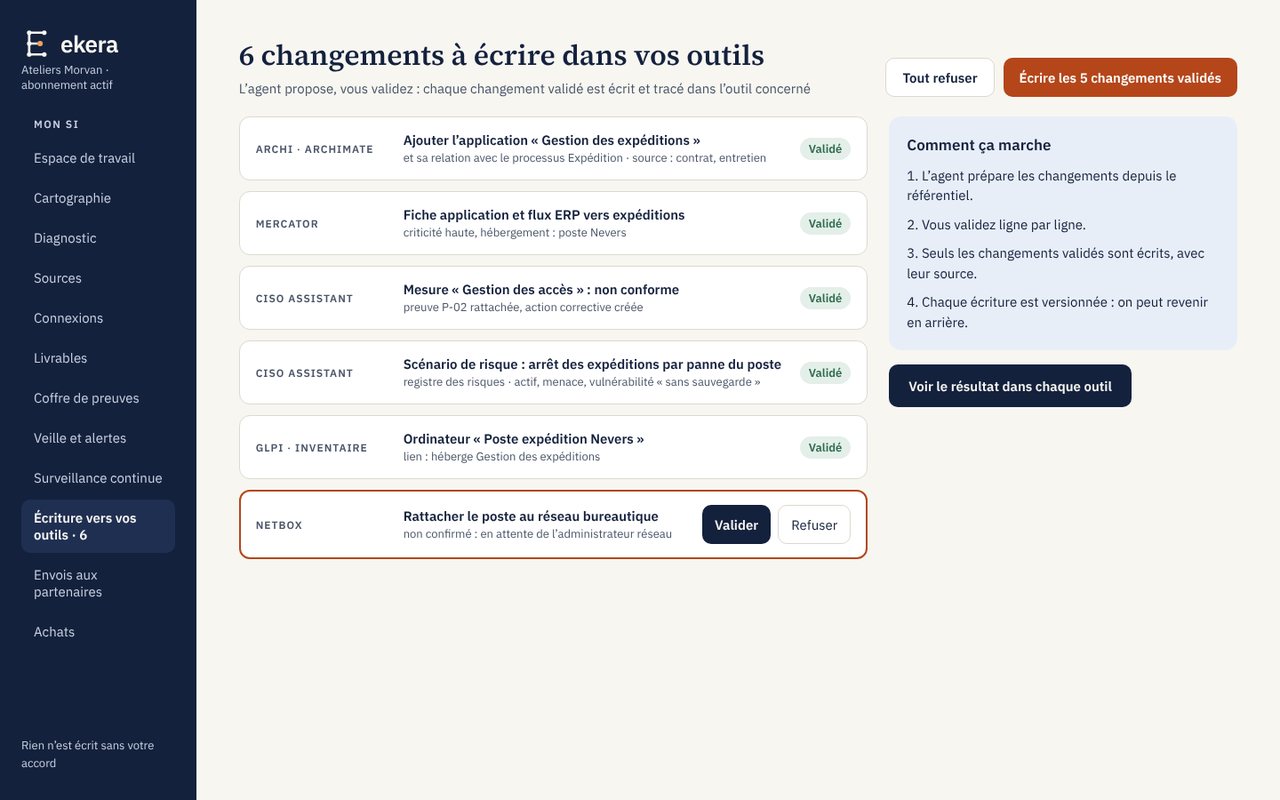
Ekera writes into GLPI, CISO Assistant or Mercator what you have decided, and only after a person’s signed approval, through the process agreed with you. Every write is traced: who approved it, when, what changed. Ekera never deletes anything; a mistake is undone or compensated by a reverse operation when the tool allows it.

Three situations

Three common situations

NIS2

Prepare for NIS2 compliance

Identify the gaps between your situation and the applicable requirements, map critical dependencies and organise the evidence needed to track them. Ekera helps structure the assessment and prepare your roadmap; it does not, on its own, deliver a compliance certification.

Discover the NIS2 assessment
Acquisition

Assess an information system before an acquisition

In a deal, IT risks weigh on business continuity, future investment and the value of the company. Ekera structures the available information, identifies points of attention and estimates remediation costs, from the accessible documents, with no direct access to the target’s systems.

Discover IT due diligence
Architecture

Equip your enterprise architecture team

Automate part of the collection, analysis and documentation to spend more time on decisions. Ekera links business needs, applications, infrastructure and technical solutions; it prepares change scenarios and the related documents, which your architects check and approve.

Discover enterprise architecture
Why now

Cyber risk is becoming an investment question

Companies need to know their IT dependencies better, justify their security investments and document the measures they put in place. Yet decisions remain hard: technical teams describe vulnerabilities, while management arbitrates budgets without always having a shared estimate of the economic consequences.

1,251 cyber claims paid to companies in France in 2025, up from 448 in 2024.
248 claims paid in 2025 for 2,002 insured mid-sized companies, about 12% in a single year.
Over 15,000 entities covered by NIS2 in France according to ANSSI, the French national cybersecurity agency, up from about 500 under NIS 1.
Required by ANSSI’s Référentiel Cyber France (working draft, March 2026): an IT map kept up to date.

Three shifts reinforce this need

Interdependent information systems

An outage or a compromise can affect several applications, infrastructure components and business processes. Understanding these dependencies helps anticipate the consequences of an incident.

Growing security and traceability requirements

Companies must identify their risks, justify their security measures and document their decisions. A structured map makes this easier and lets you track how the system changes.

Budget decisions that are hard to arbitrate

Security measures keep multiplying, but they do not all have the same cost or the same effect on risk. Comparing them helps target investment.

Meanwhile, cyber insurance rates are falling: −4% worldwide in the second quarter of 2026, the twelfth quarter of decline in a row. In a more competitive market, telling risk profiles apart can become an advantage for insurers; verifiable information on architecture can contribute to it.

And attacks are changing scale: in July 2026, Hugging Face confirmed an intrusion carried out by an autonomous AI agent. Faster attacks call for better preparation: knowing the dependencies between applications, infrastructure, identities and processes before the incident, so you know at once what is affected.

In France, the law transposing NIS2 has not been passed yet. But your customers, your insurers and your buyers are already asking the same questions.

Sources: AMRAE, LUCY 2026 study (2025 data); Marsh, Q2 2026 ; Hugging Face, 16 July 2026; Security Magazine and IT-Connect, July 2026; Vincent Strubel, Director General of ANSSI, before the French Senate, December 2024; Référentiel Cyber France (ReCyF) v2.5, objective 5, measure 5.A.1, working draft of 17 March 2026.

Ekera brings these three issues together: understanding the system, estimating the consequences of an incident and choosing which measures to fund.

The common thread

From mapping the information system to the investment decision

Ekera helps companies understand their information system, estimate the financial consequences of its weaknesses and choose the work that reduces their exposure the most. From your documents, your tools and your teams’ knowledge, it builds a documented map, finds the critical dependencies, analyses attack and outage scenarios, then estimates their consequences from your data and explicit assumptions. Results are sourced, assumptions are visible, and decisions stay in your hands. Every module below follows from this mechanism.

Ekera’s modules

One product, one map: modules are switched on as you need them.

ModuleIts role in the decisionScreens
IT mappingUnderstand the components of the information system and their dependencies.Document upload, AI-led interview, IT mapping, Sources and connectors, Read-only connections, Approved writes
Risk analysisFind possible failures and attack paths.Assessment and priorities, Impact calculated before building
Costing in eurosEstimate the financial consequences of each scenario.Query the map, Impact calculated before building
Action planCompare, for three budgets, the work that reduces the estimated risk the most.Purchasing: quotes, orders, contracts, ABB and SBB catalogue, Sourcing and decision, Weighted sourcing
Enterprise architecturePrepare and document change decisions.From Archi, Document chain, Reading portal, The need and its versions, Proposed architecture, Package for generators, Check before production, ABB and SBB catalogue
NIS2Identify gaps and organise the evidence.Assessment and priorities, Vault
Continuous monitoringSpot the changes that call earlier analyses into question.Monitoring and proposals, Monitoring agent

Are you an insurer or a broker? Discover Ekera Assurance, our product for insurers →

Costing in euros

Link technical risks to their financial consequences

A list of vulnerabilities is not enough to decide which measures to fund. Ekera estimates the financial consequences of the scenarios studied from your data, notably accounting and operational data, and explicit assumptions.

Four notions to keep apart

The cost of a scenario

What a given incident would cost

Depending on its duration, its scope and the assumptions made. The worst scenario is broken down line by line and compared with your insurance limit.

The estimated annual loss

The average loss per year

What the scenarios studied would cost on average each year, as a range.

How it is calculated

Given the frequencies and consequences used in the model: for each scenario, estimated frequency × loss, added up. It is given as a range because frequencies, downtime and response costs are uncertain.

The effect of measures

The modelled risk reduction

The estimated drop in risk in the modelled scenarios, if the measures considered are implemented. It is a change in risk, not an avoided expense.

The saving achieved

An expense actually avoided or reduced

A cancelled licence, a purchase that no longer happens: it shows in your accounts, as distinct from a theoretical gain or time freed up. These four figures are not interchangeable; each comes with its definition, assumptions and limits.

Reproducible calculations

Your accounts, read on site

The figures are produced by the calculation engine, independently of the language model: same data, same result.

How it is calculated

Reproducible does not mean exact: the result is only as good as the data and assumptions. The French accounting entries file (FEC), which every company can produce, gives revenue and variable costs; the margin is split across your revenue streams, each counted once. Data, parameters and sources are shown so you can discuss them with your technical and finance teams.

The cost of the work

Costs that become more precise

  1. Order of magnitude from the catalogue (estimated)
  2. List price times your quantities, or a sourced, dated range when the price is only given on quotation (calculated)
  3. Quotes from your suppliers, requested by your purchasing team once the work is decided (confirmed)
  4. Actual cost after completion, read on the invoice when available (invoiced)

Today, the costs shown are illustrative orders of magnitude, to be confirmed by quotes. If the ranking of the variants changes between the low and high ends of the price ranges, Ekera flags it.

The goal: a well-argued basis for comparing investments, without confusing an estimate with a guaranteed result.

Collective decision

A shared basis for your IT and financial decisions

One assessment, several viewpoints: for each function, Ekera prepares the page that concerns it, calculated by the engine. A work scenario goes through your approval flow before anything is written into your tools.

  1. CIO Sees the dependencies and weak points, and compares change scenarios.
  2. CISO Links technical findings to business processes, documents risk scenarios and prepares the roadmap.
  3. CFO Reviews the cost of measures, the estimated financial consequences and the expected risk reductions.
  4. Purchasing Prepares requests for quotes and compares options based on needs, what exists and documented prices.
  5. General management Receives a summary of the stakes, scenarios and proposed trade-offs, and decides.

Each person approves, rejects or asks for a change from their email or Teams. The flow adapts to your organisation: the CFO only above a certain amount, for example. Decisions and opinions are traced; nothing is written into your tools before.

Who it is for

For mid-sized companies and large SMEs, and each of their decision-makers

Companies without a well-staffed architecture or security team still need to understand their information system and justify their investments. Ekera automates part of the analysis and documentation, without replacing the company’s managers.

Mid-sized and larger SMEs

No dedicated CISO

Roughly 100 to 500 employees, industry first. The CIO does everything, often alone: Ekera brings them the analysis and documentation work of an architecture and security team; they keep the decisions.

CISO

The lone CISO

Roughly 500 to 1,000 employees. The CISO has the responsibility without the team: Ekera takes on the architecture analysis and documentation and feeds their steering tools, without replacing them.

Large groups and funds

Architects and acquirers

For architecture teams: building-block catalogue, scored scenarios and a panel inside Archi, with an annual licence. Before an acquisition: an IT due diligence in ten days, with no direct access to the target’s systems.

What each decision-maker gets

CIO

Understand and prepare change

A documented map, identified dependencies and change scenarios to arbitrate projects. Page for the CIO

CISO

Link risks to the business

Documented scenarios, identified sources and a roadmap to prioritise security measures. Page for the CISO

CFO

Compare costs and risks

Explicit financial estimates and comparable scenarios to inform investment decisions. Page for the CFO

Architects

Automate the analysis

A shared basis to prepare scenarios, deliverables and architecture decisions.

Insurers and brokers

Enrich the information

Structured indicators on architecture and prevention, under the agreed sharing arrangements. Ekera Assurance

Find your use case

The workspace

Ask a question. Review the sources. Prepare your decision.

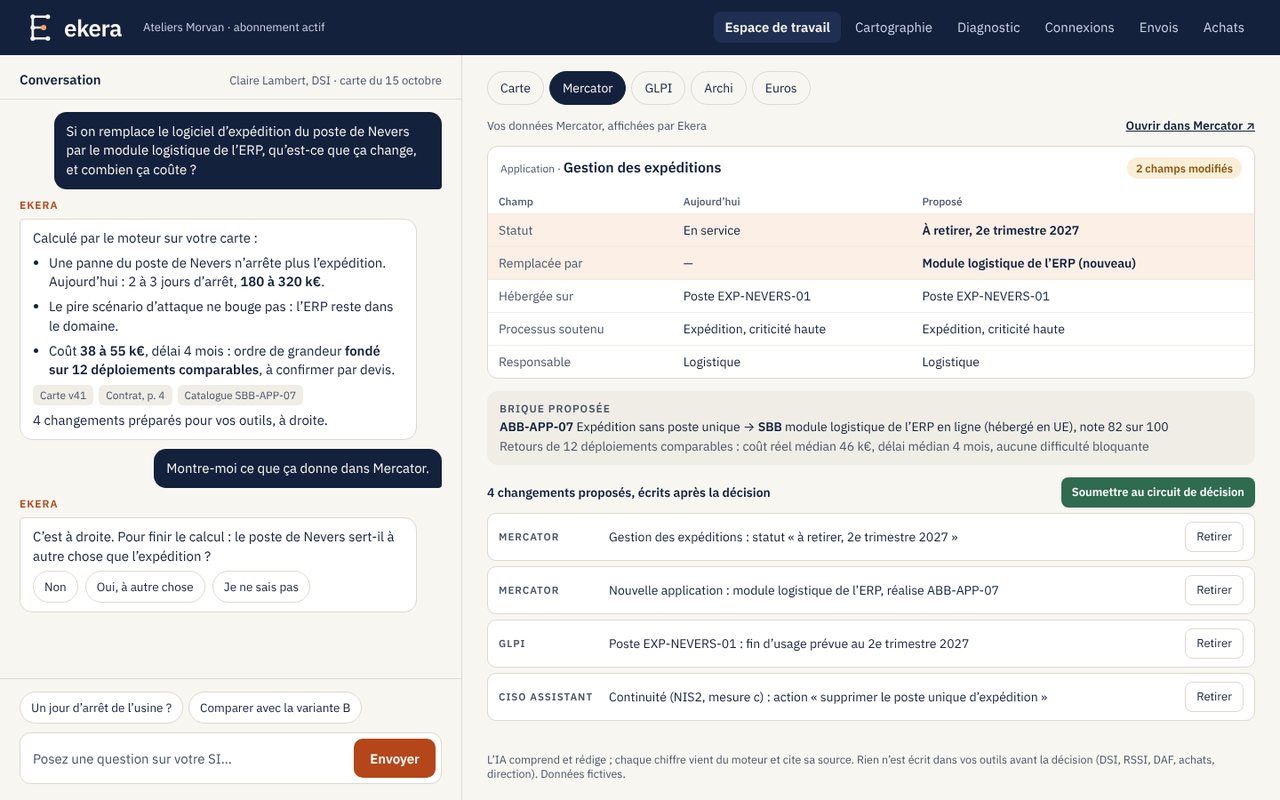
  • Query the map in plain language: “what would happen if our ERP were unavailable for three days?” Ekera shows the processes affected, the dependencies and the financial estimate, when the data allow an answer.
  • Or: “what would replacing our shipping application change?” If information is missing, Ekera says so instead of giving an unsupported answer.
  • Every finding links to its sources; calculated figures are kept apart from declared information and assumptions.
  • Those who do not log in receive a weekly summary, with the approvals to give.

The point is not only to get an answer, but to understand what it rests on.

Take the guided tour (in French) Mock-up, fictitious company
Ekera screen: workspace, conversation on the left and Mercator record on the right, fictitious data
Mock-up, Ateliers Morvan (fictitious company).
The product

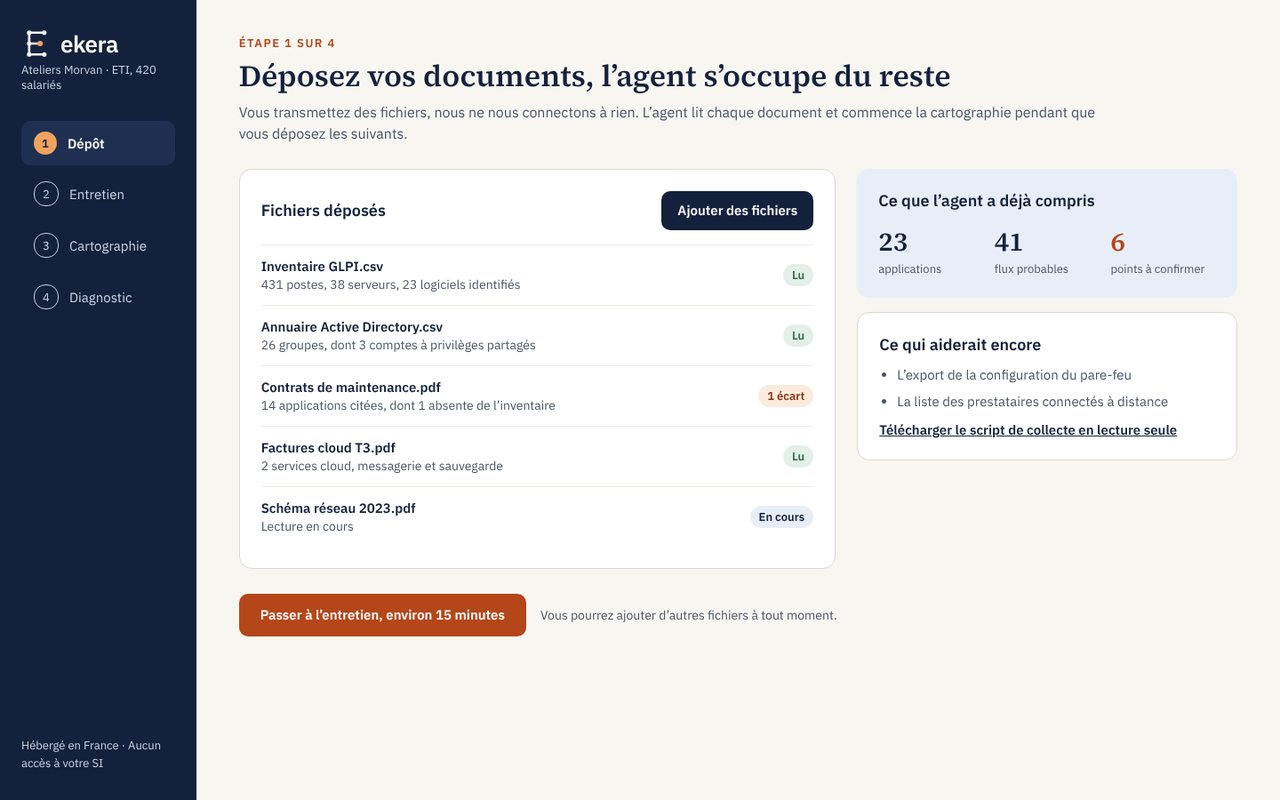
Ekera in screens: from your documents to risk in euros and the NIS2 assessment, then continuous monitoring

Fictitious example. The screens show Ateliers Morvan, a fictitious industrial mid-sized company with 420 employees, with fictitious data.

Module: IT mapping

Ekera screen: document upload, fictitious data
You upload what you have. Diagrams, contracts, inventory or directory exports, invoices. Ekera reads the files, with no direct access to your systems.
See the demo (in French) Clickable seven-step walkthrough, about five minutes, fictitious data.
Enterprise architecture

From need to application: your IT keeps pace with the business, in real time

The need

  • The business wants its applications in days, not quarters, and its needs change from one week to the next
  • Tools that generate code and infrastructure are fast, but they ignore your real IT: dependencies, sensitive data, company rules, NIS2
  • The result: applications built in a vacuum, which security either blocks or lets through without seeing them

Ekera’s role

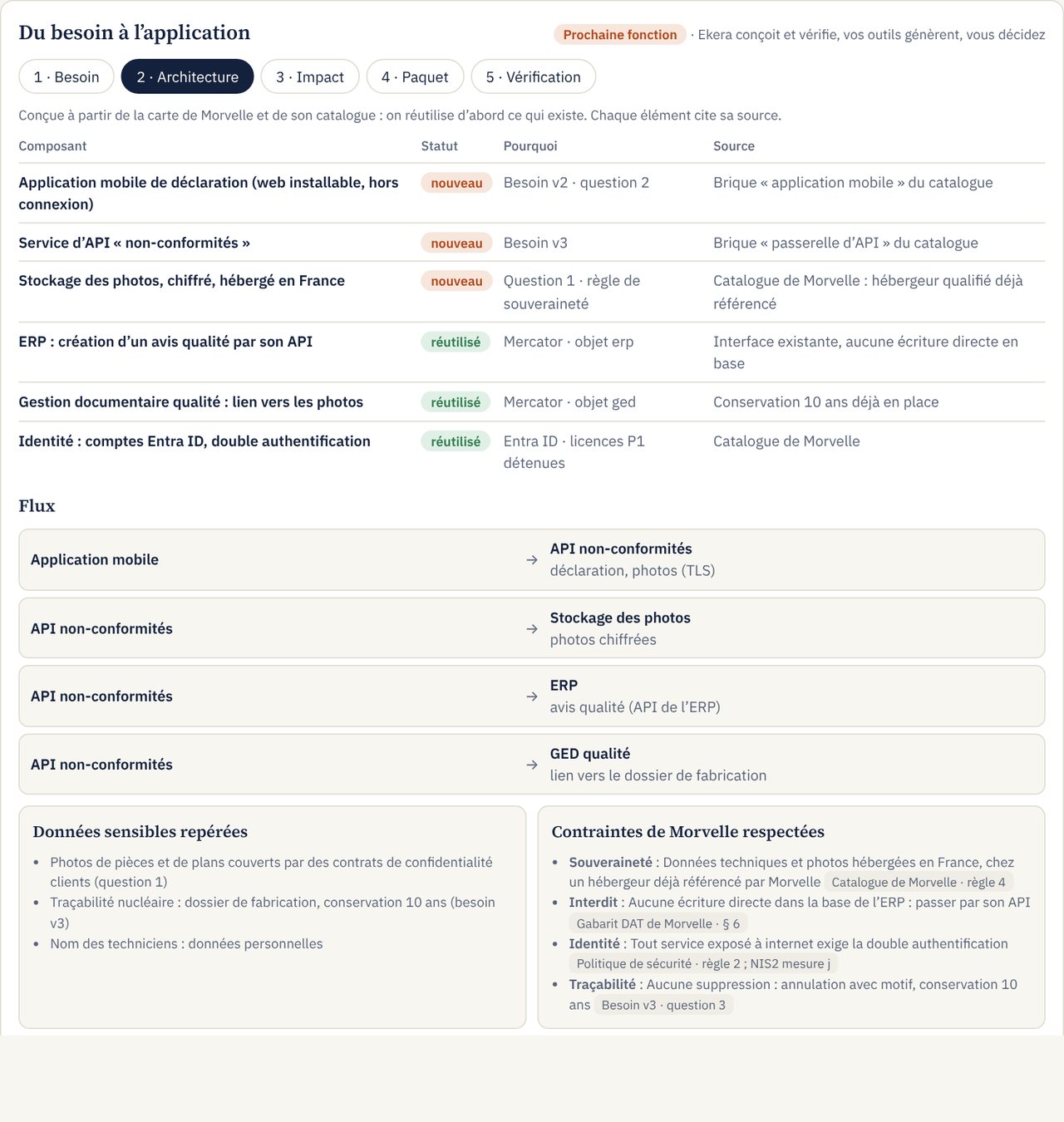
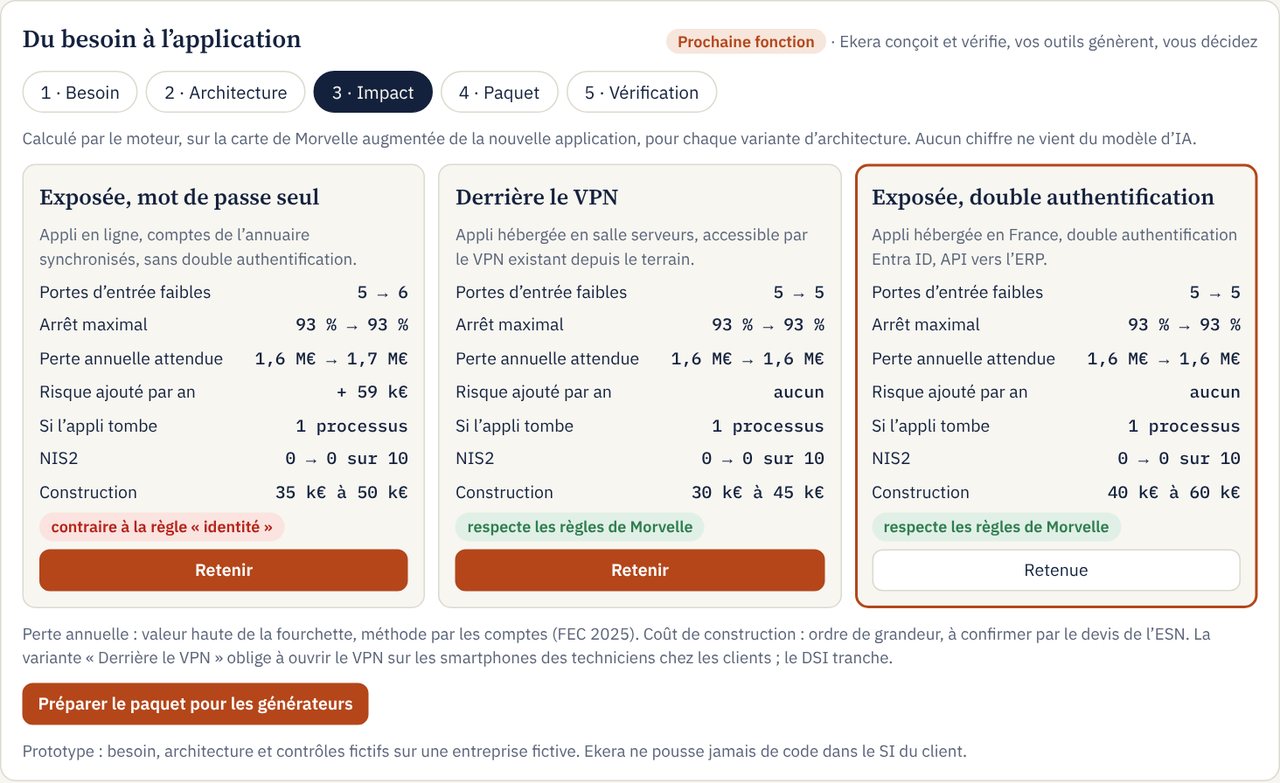
  • The plan: from the map, the target architecture and the API contracts, reusing what you already have first
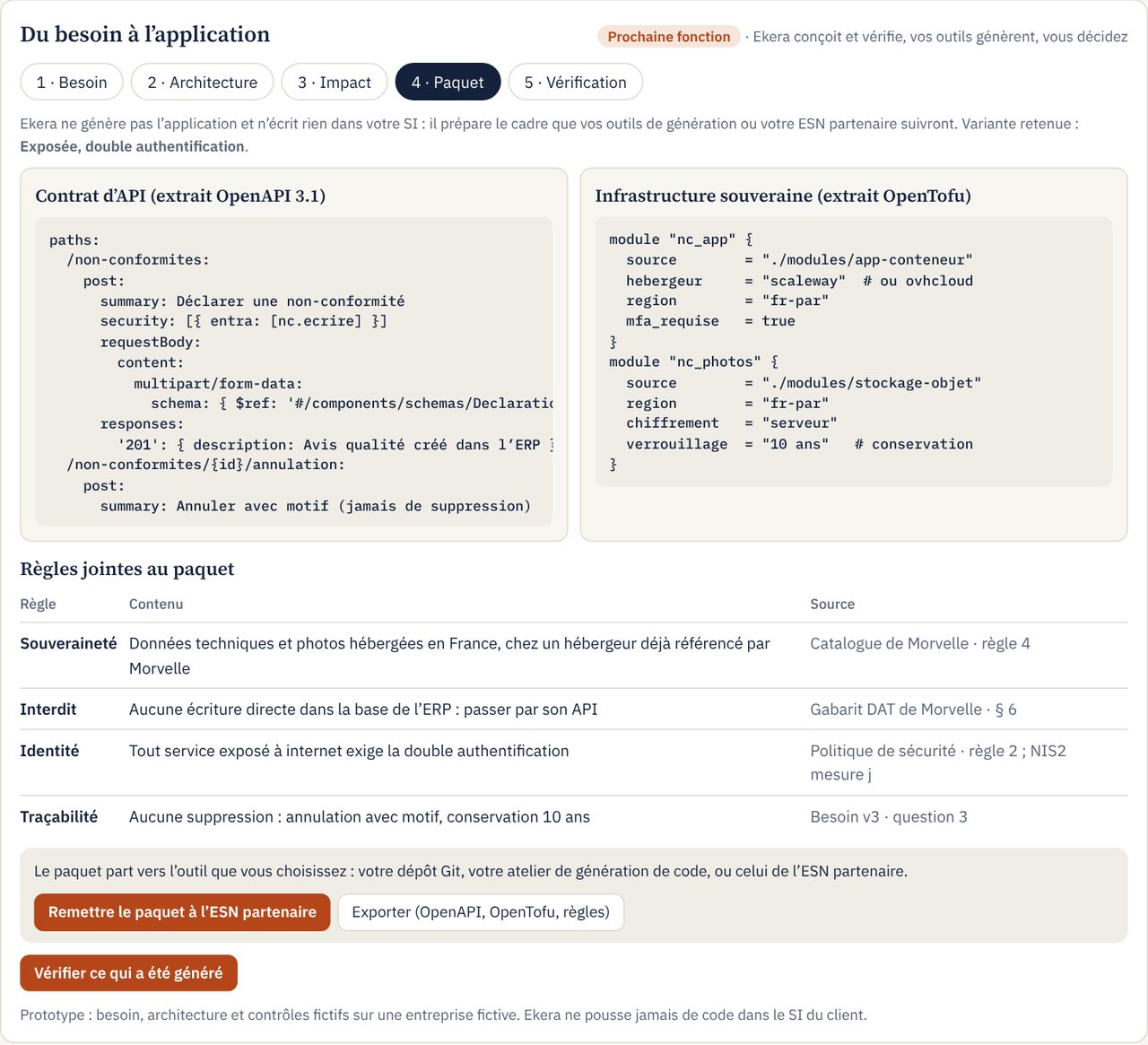
  • The constraints: your sovereignty rules, your prohibitions and NIS2, attached to the package handed to your generation tools or your IT services firm
  • Risk priced before building: the engine compares the variants in euros
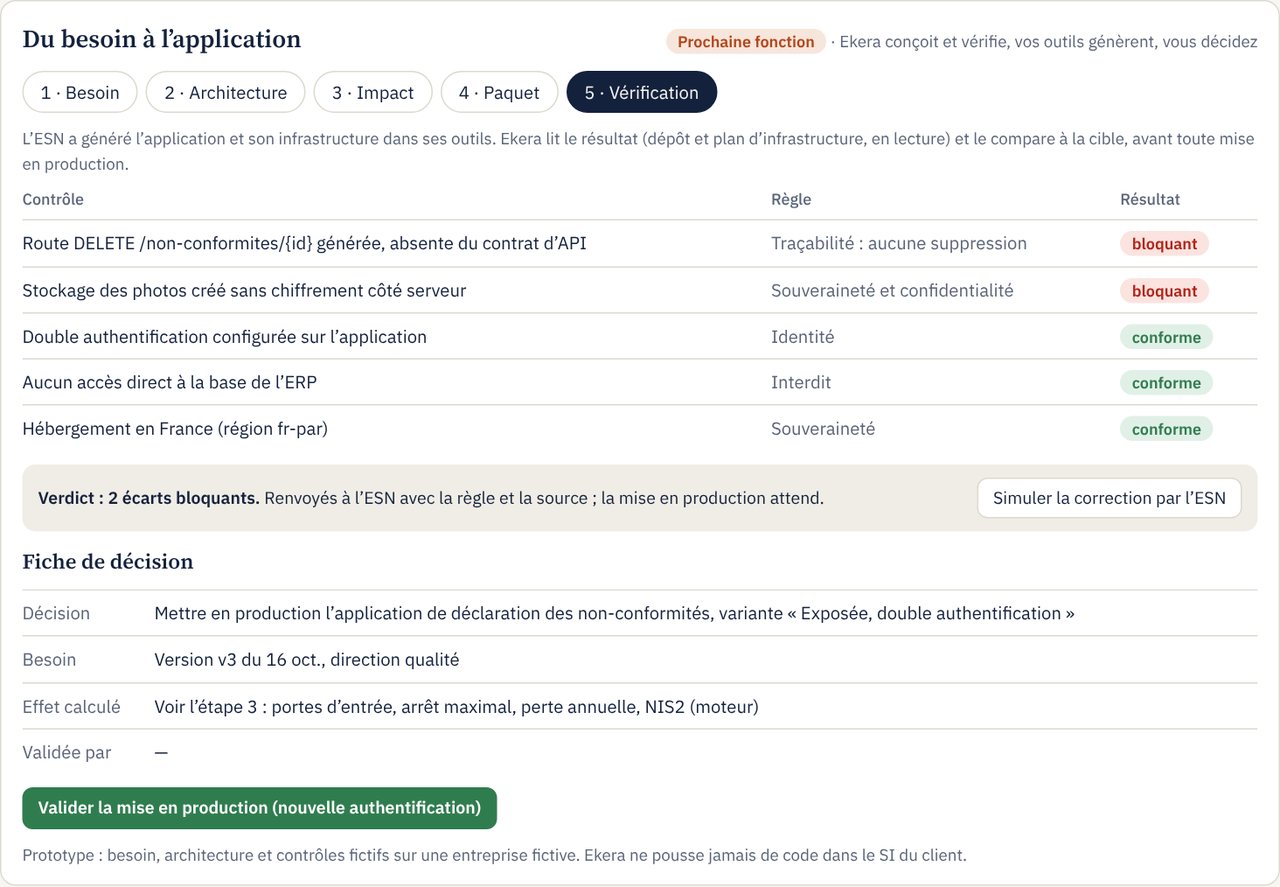
  • Verification before go-live; the map updates itself, you decide

Complementary to code and infrastructure generators, not a competitor: Ekera designs and verifies, your tools or your partner IT services firm generate. Ekera never pushes code into your systems.

Module: Enterprise architecture

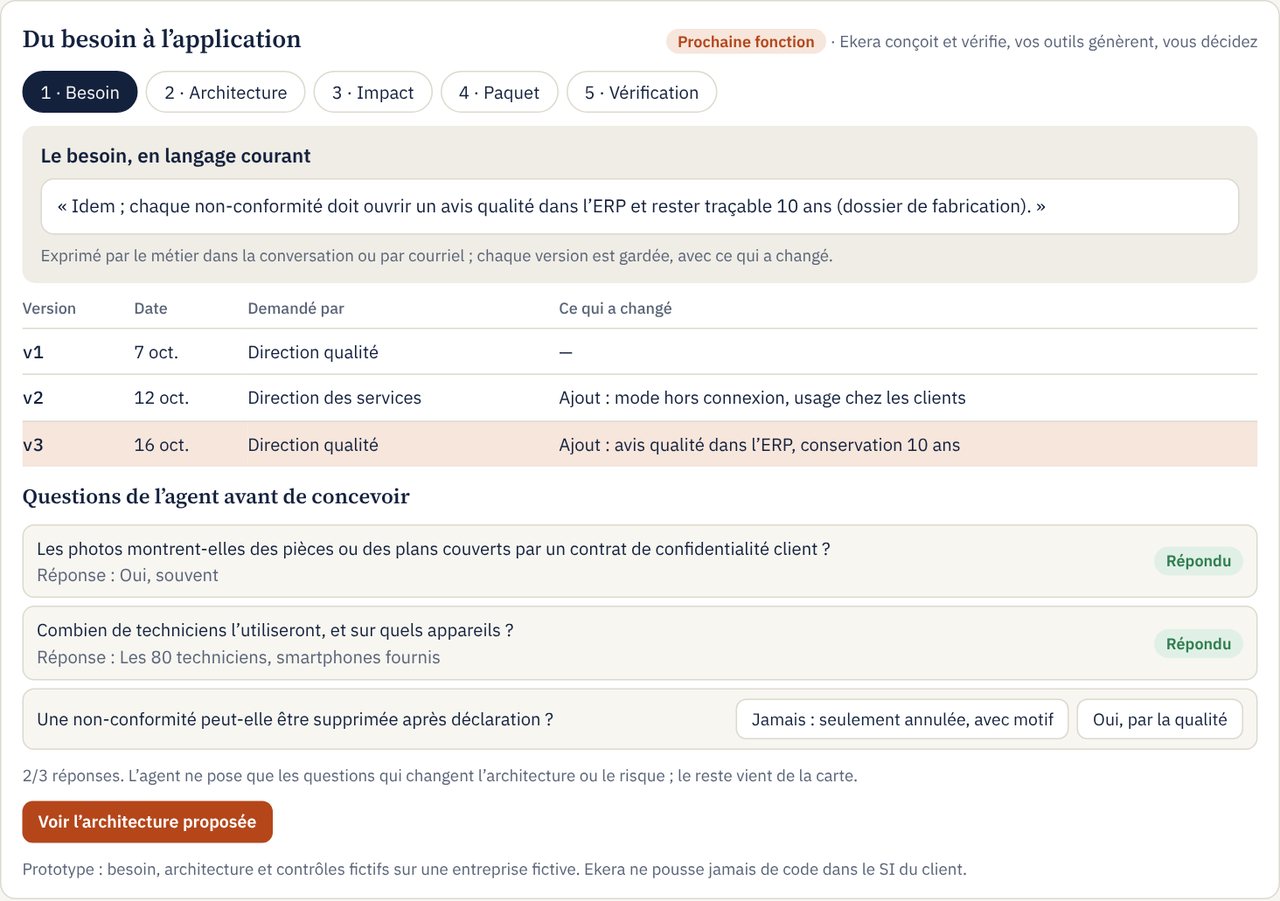
Ekera screen: business need, successive versions and the agent’s questions, fictitious data
The need, as the business expresses it. Every version is kept with what changed; the agent only asks the questions that change the architecture or the risk.
Day to day

Sourcing, monitoring, documents and vault

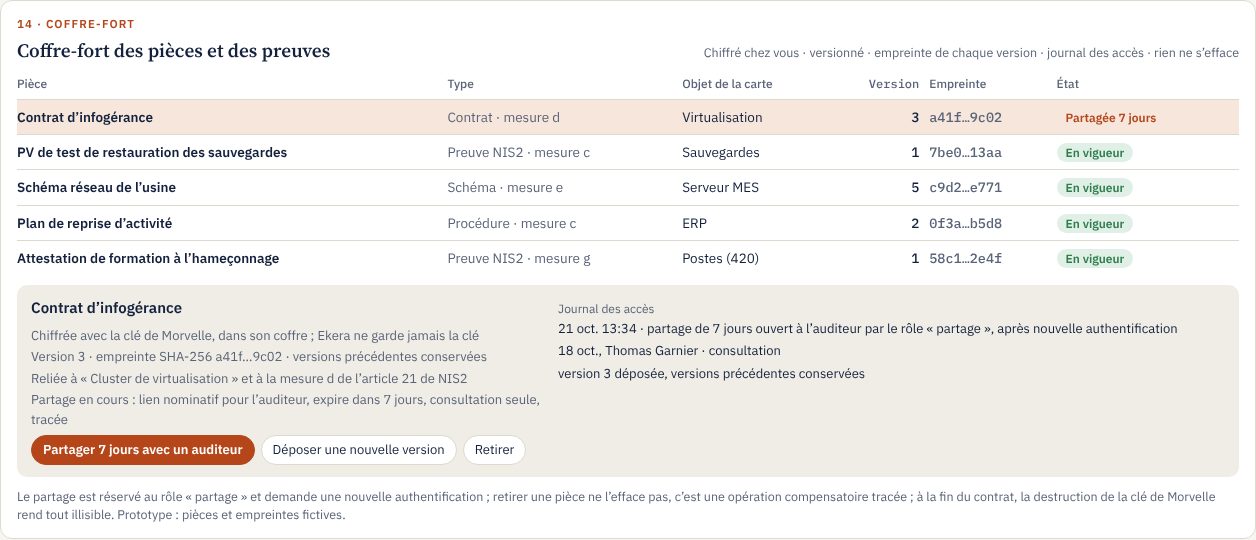
What the architect and the CISO do every week, kept up to date from the map: choosing a product, following alerts, publishing documents, keeping evidence.

Module: Action plan

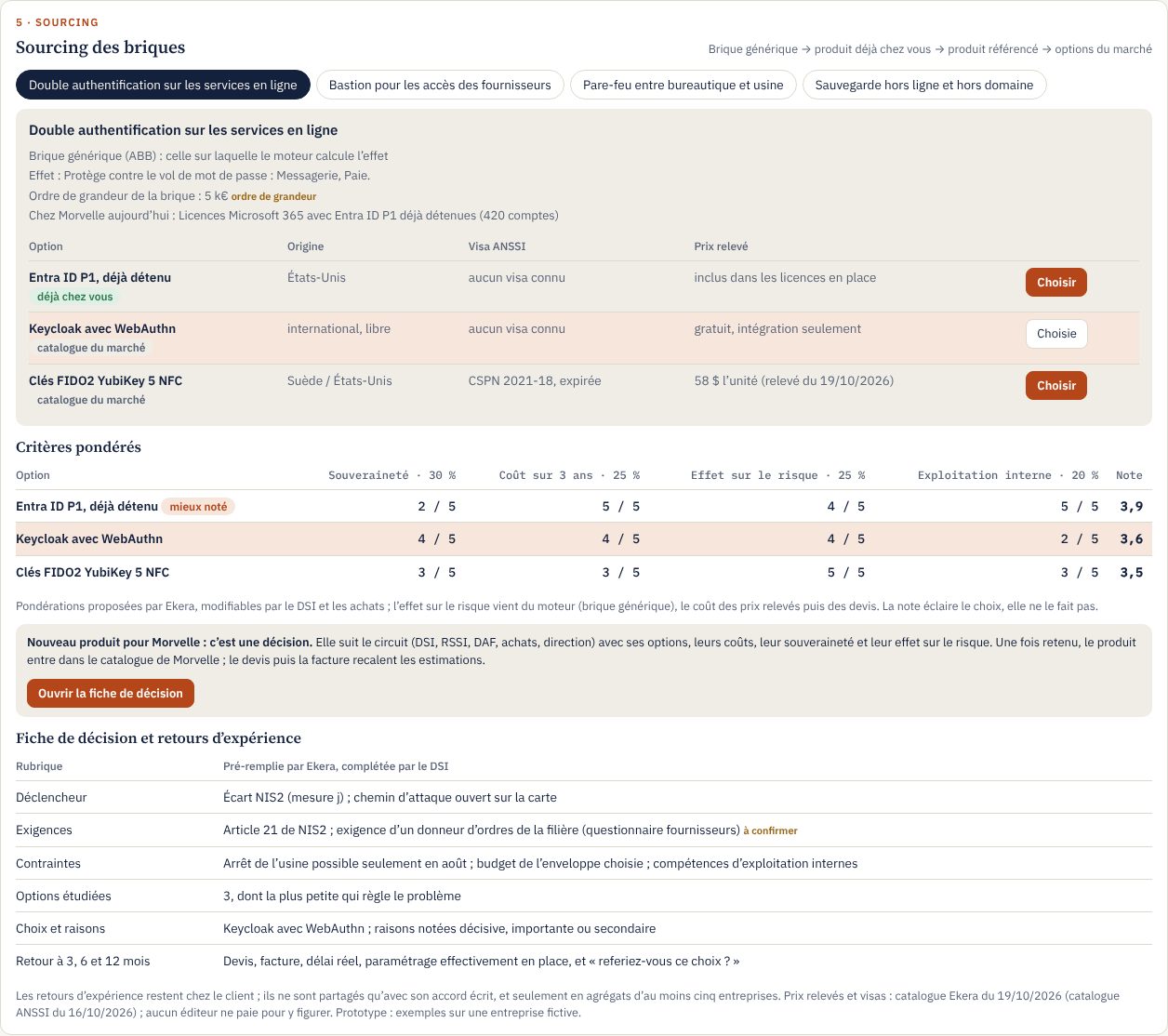
Ekera screen: sourcing a building block, market options and products already owned, weighted criteria, fictitious data
Sourcing building blocks. For each need: what you already have, your approved products, then market options with origin, ANSSI approval and recorded price, scored on weighted criteria. Every new product is a decision, with its record.
What you receive

Mapping, NIS2 compliance, risk in euros: deliverables drawn from the same map

Every deliverable is filled from the map: each value cites its source, the figures come from the calculation engine, and whatever no source establishes stays marked “to be completed”.

NIS2 compliance Gaps per measure, audit file, mapping to ISO 27001 and NIST
Mapping Applications, flows, capabilities, infrastructure
Risk in euros Worst case, expected annual loss, line-by-line breakdown
Costed variants Three budgets: cost, loss avoided, measures covered
Cybersecurity Exposure, published vulnerabilities linked to your processes
Continuity Single points of failure, recovery requirements
Obsolescence and portfolio End-of-support dates by year; keep, migrate or retire; unneeded licences
Suppliers Supplier access, security clauses to add
Questionnaires Insurers and key customers, pre-filled
Steering One-page summary for management, roadmap
Due diligence Quality score of a target’s IT, cost of remediation
Enterprise architecture Scenarios, ABB and SBB, diagrams, technical architecture documents, accreditation, HLD, EBIOS RM

The document chain

  1. 1 · Template Yours Your template for technical architecture documents or HLD, or ANSSI’s for accreditation and EBIOS RM.
  2. 2 · Filling From the map Ekera fills in what the map establishes, each value with its source and the figures from the engine; the rest is marked “to be completed”. No text is written by a model.
  3. 3 · Review By the architect In Ekera’s “Documents” screen, the architect corrects, completes and approves, section by section.
  4. 4 · Distribution Word, PDF or online Download as Word and PDF; optionally, publication to your document tool, SharePoint or Confluence, with the date and the approver’s name.
  5. 5 · Feedback Back to your repositories Approved changes flow back to Archi, Mercator or GLPI, one by one.

The same cross-check of directory, inventory and contracts spots unused licences: disabled accounts that keep a licence, software installed but never opened. Every line cites its source; you decide what is returned.

Your tools

Build on what you have rather than rebuild your information system

The initial assessment relies on your documents and exports. To keep the map up to date, Ekera can then use connectors, read-only APIs or a collector installed on your premises, depending on the integrations available; access arrangements are defined with your IT team. Your management, inventory, architecture and compliance tools remain your references: Ekera complements them, and writes to them only after approval, within each tool’s rights and capabilities. One tool is authoritative for each type of object.

Your changes stay under your control: approval, traceability and rollback.

What is storedReference toolWhat Ekera readsWhat Ekera writes, after approval
Architecture views and scenariosArchiThe model, at every saveProposed views and relationships
Applications and flowsMercatorApplications, flows, ownersStatuses, new applications, building blocks
EquipmentGLPI or iTopWorkstations, servers, software and versionsEnd of life, backups, failover
NetworkNetBoxZones and crossings between zonesCrossings to filter
ComplianceCISO AssistantControls and evidenceNIS2 actions, dated evidence
Purchasing and suppliersYour purchasing softwareQuotes, orders, contracts, suppliers, invoicesQuote requests, approved by your purchasing team; never an order

Do you use other open tools, such as MONARC for risk analysis? Ekera can connect to them on request.

Connector status

With AI, connecting to a new application no longer takes months

The connector is written in a few days from the vendor’s documentation, then tested on your premises before it reads anything.

Supported: some fifty software products, 18 families

  • 11 direct: Active Directory, Entra ID, Intune, GLPI, FortiGate, vSphere, Veeam, Tenable, Greenbone, CISO Assistant, Mercator
  • 36 more through their exports
  • Your PDF, Word and Excel documents, whatever their origin

What has been tested

  • The eleven direct connectors were written in a few days
  • Then tested on real instances: Samba AD directory, Greenbone, Mercator, GLPI 10, 11 and 12
  • Your tool is not on the list? All it needs is an API or an export
Connecting a source

Every connector is tested before reading, and your secrets stay with you

Three ways to read

  • An uploaded file: inventory, directory or firewall export, accounting entries file
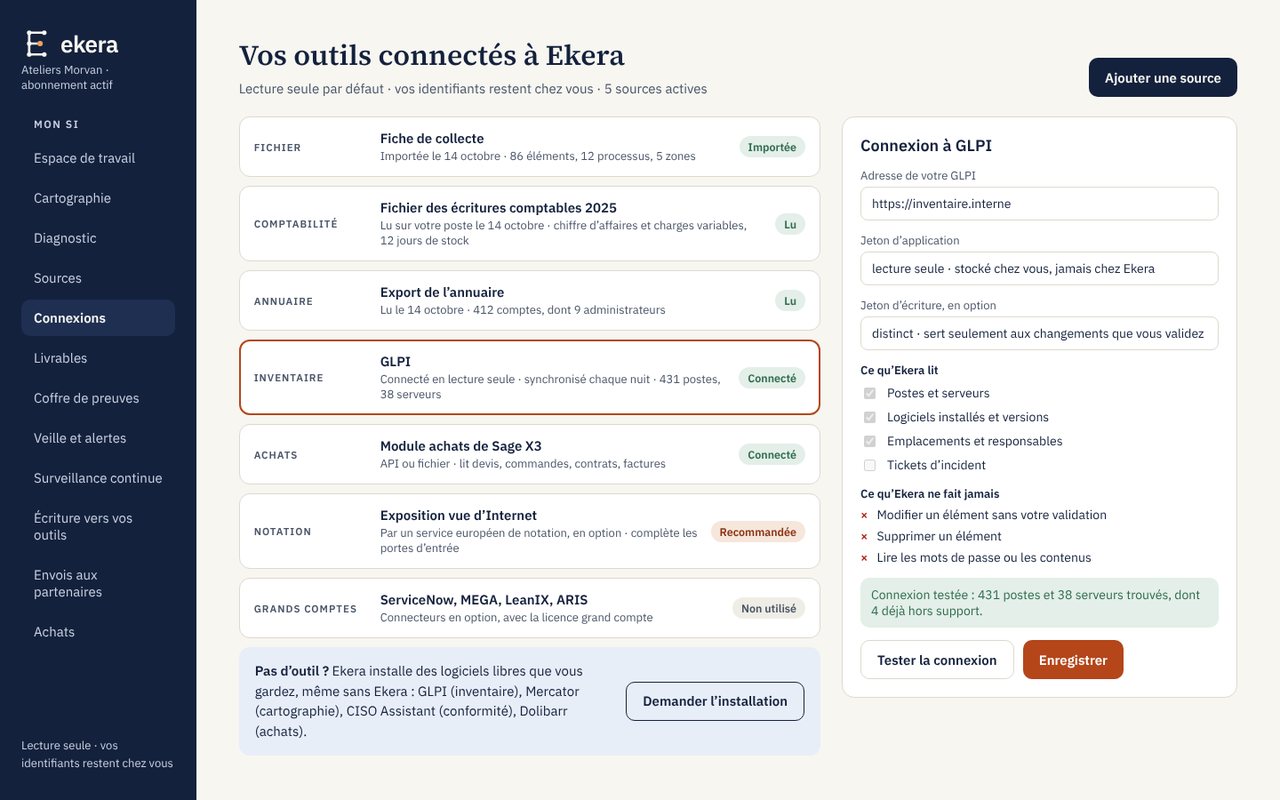
  • A read-only API, with a dedicated account that you create
  • A collector installed on your premises, which sends its readings without opening an inbound port

Traceable data: for each source

  • Its origin and the information used in the analysis
  • A connection test, and a clear reason when it fails (expired certificate, missing permission)
  • The date of the last read, and an alert when a source is out of date
  • A vault reference instead of the password: Ekera never keeps its value
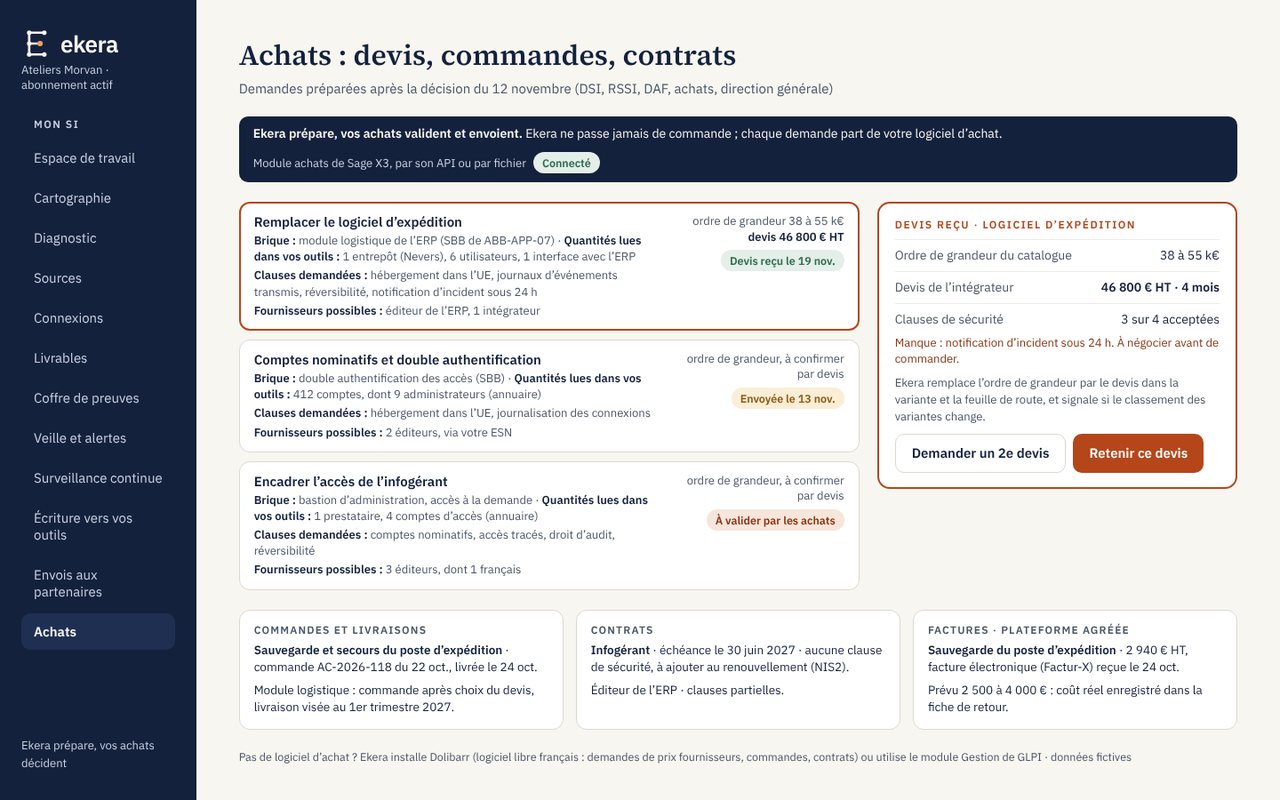
With your purchasing software

Work priced with real prices, and followed through to the invoice

Ekera prepares, your purchasing team approves and sends

  • Once the decision is made, one quote request per selected building block
  • Quantities read from your tools: accounts, workstations, servers, sites
  • The security requirements and NIS2 clauses to put in the contract
  • Possible suppliers

Ekera never places an order.

Ekera reads back

  • Quotes, which replace the order of magnitude in the variants
  • Orders and delivery dates, which track the roadmap
  • Contracts and suppliers, for the NIS2 supply-chain measure
  • Invoices, which give the actual cost. Since 1September 2026, every company in France must be able to receive electronic invoices; when your supplier already issues them, the actual cost is read with no re-keying

Your purchasing software is usually the purchasing module of your ERP (Sage X3, Divalto, Cegid, Microsoft Dynamics 365, SAP) or a procurement suite (Ivalua, Coupa, SAP Ariba). Without a purchasing tool: Dolibarr, French open-source software, or the GLPI Management module.

Your tools Archi, Mercator, GLPI, NetBox, CISO Assistant, purchasing software
→↓ continuous reading: every change triggers a recalculation←↑ approved writes, one by one, reversible
Ekera map, calculation engine, building-block catalogue
→↓ indicators, with your consent←↑ anonymised claims, to refine the calculation
Your insurer or your broker
From the conversation The CIO asks a question; Ekera answers with the map, the euros or the tool record, and prepares the changes.
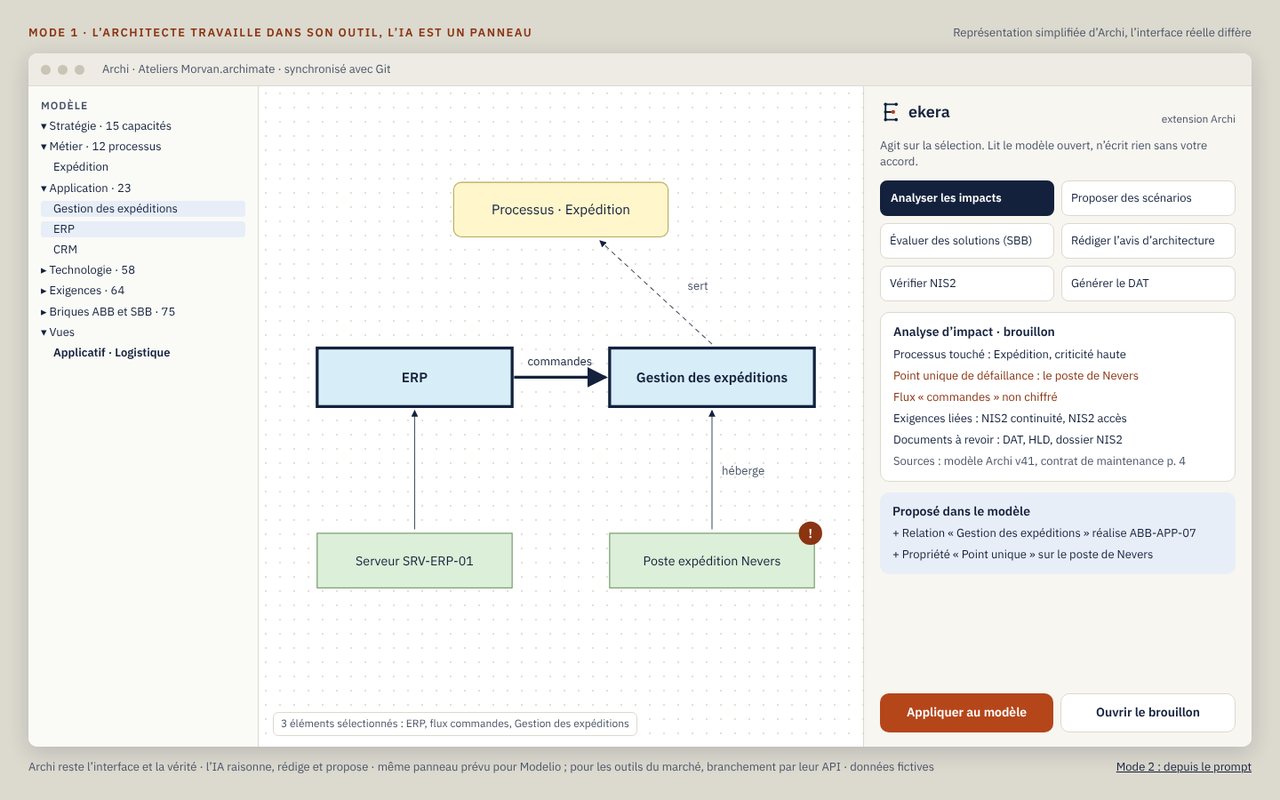
From your tool The architect selects objects in Archi; Ekera analyses impacts, proposes scenarios, prepares the opinion and fills in the technical architecture document.
An architecture ontology The agent reasons on linked concepts: “Sage X3”, “sales management” and “SRV-ERP-01” are one and the same ERP.
You do not have these tools? Ekera can recommend open-source software, on an equal footing with commercial offers: GLPI, Mercator, NetBox, CISO Assistant, and Dolibarr for purchasing. Your team, a partner IT services firm or the vendor installs it; it remains yours, even if you leave Ekera.
Enterprise architecture

From business need to target architecture, taking what exists into account

IT projects must respect the company’s business, technical, economic and security constraints. Ekera links these constraints to the map to prepare architecture scenarios and assess their consequences.

Reuse before adding

Start from what exists

The analysis starts with the components and solutions already in your IT: possible reuse, dependencies involved, needs that call for a new solution.

Compare before building

Scored scenarios

Scenarios are compared by their consequences on architecture, risks, costs and identified constraints; the engine prices each variant.

Document decisions

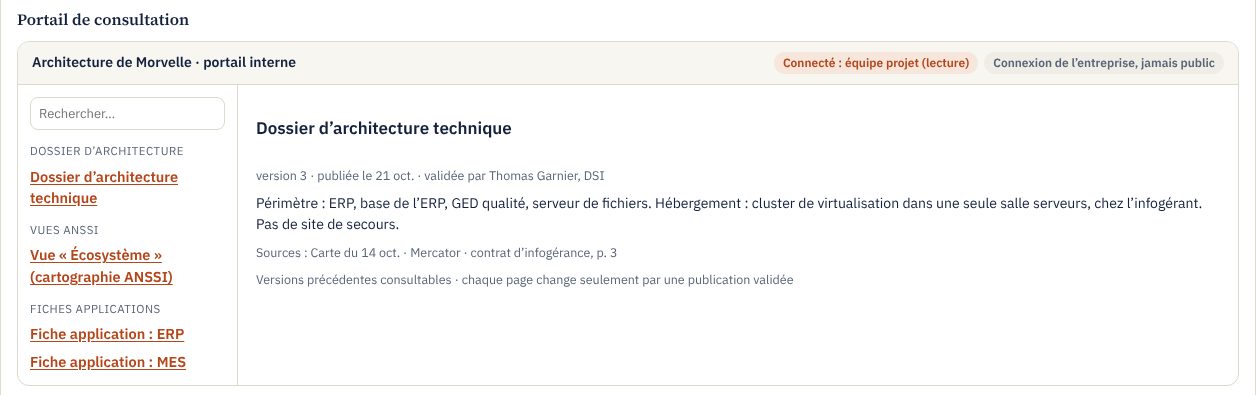
Your deliverables, filled from the map

Technical architecture documents, security accreditation file, HLD, EBIOS RM: Ekera fills what the map establishes, each value with its source, and marks the rest “to be completed”; the responsible architects review and approve in Ekera before any publication.

Towards your development tools

Complement development tools

The target architecture and your constraints are handed to your code or infrastructure generation tools, or to your teams. Generation, verification and release to production stay separate, with a check at each step.

An Ekera panel inside the Archi tool and the building-block catalogue are shown in the screens; the need-to-application journey, in its screens, fictitious data.

Catalogue and purchasing

Compare solutions before investing

A security measure can be implemented in several ways: the choice depends on requirements, tools already in place, costs and constraints. Ekera structures this comparison, starting from the need, what exists and the company’s constraints.

Building-block catalogue

What is needed, and with what

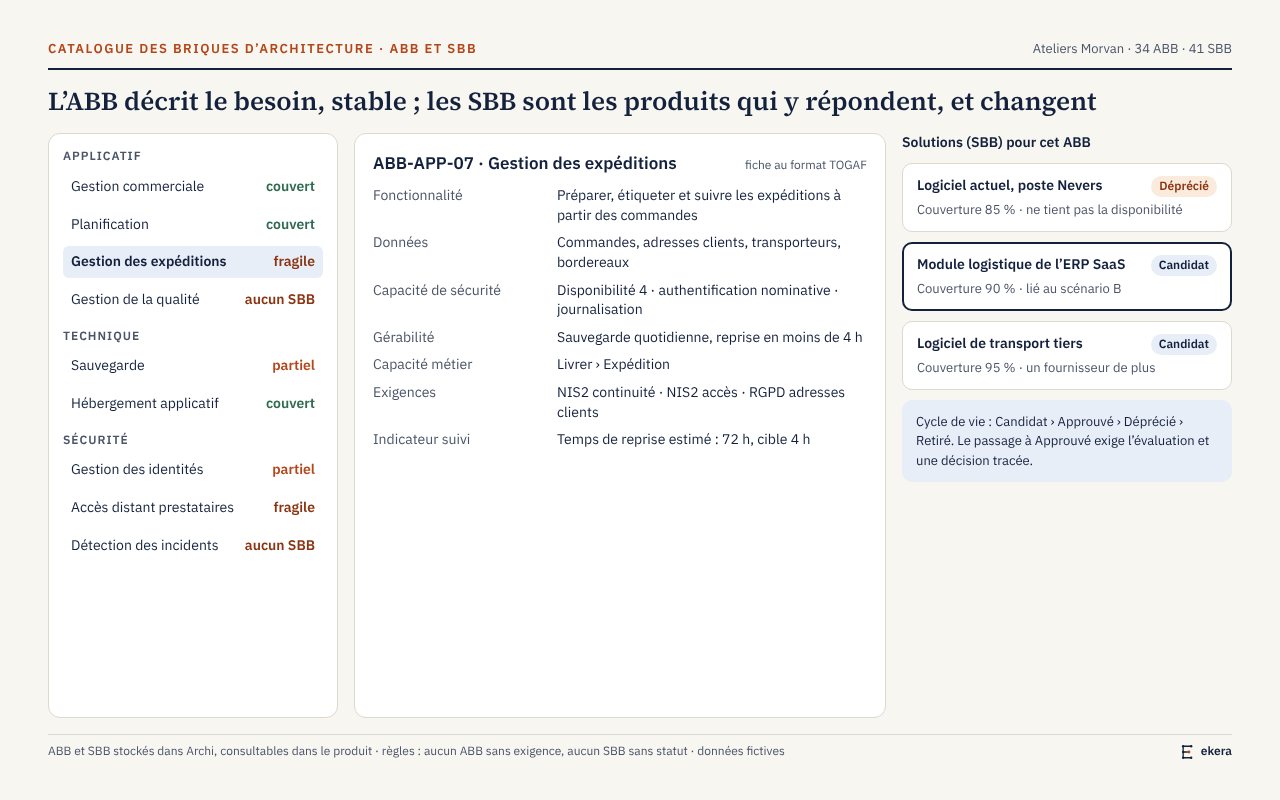
ABBs state what is needed (“remote access with two-factor authentication”), SBBs state with which solution and at what cost. Each building block is linked to security measures, NIS2 controls and the calculation: putting it in place changes the euros. A monitoring agent, an assistant that watches ends of support, vulnerabilities and prices, proposes updates; an Ekera architect approves them before publication.

Feedback base

What the work really cost

Each building block put in place produces a feedback record: planned and actual cost and lead time, difficulties met, observed effect. Anonymised and aggregated, with each customer’s written consent, these records will make estimates more accurate for the next customers: everyone benefits from the others’ experience.

Level 1 · the need

What must be ensured

Backup out of reach, control of remote access, vulnerability monitoring: the architecture needs (ABBs), common to all, linked to the NIS2 measures and the calculation.

Level 2 · available solutions

What the market offers

The solutions (SBBs) that meet the need, with their features, limits, ANSSI qualifications and list prices recorded and dated; otherwise “on quotation”, rather than an invented figure.

Level 3 · your environment

What you already have

Solutions installed, licences held, approved suppliers and your negotiated prices. This catalogue belongs to you alone.

Sourcing, in this order

  1. What you already have. A feature included in your licences, an under-used tool: often the cheapest and fastest.
  2. What your purchasing team has approved. Existing contract, supplier already assessed.
  3. The market. Two or three options compared on the same need, with sourced prices and lead times.
  4. A documented decision. Options kept and set aside are recorded with their reasons; indicative costs are replaced by quotes as soon as they arrive. Final selection and orders stay under your control.
Lessons learned

At 3, 6 and 12 months

Actual cost and lead time, difficulties met, observed effect on the calculation. Your feedback first enriches your own catalogue. It only serves other customers anonymised, aggregated over at least five companies, and with your written consent.

Continuous monitoring

A useful map evolves with your information system

Applications, infrastructure, suppliers and requirements change over time: an initial analysis loses relevance if it is not updated. Ekera spots the changes that may alter earlier findings.

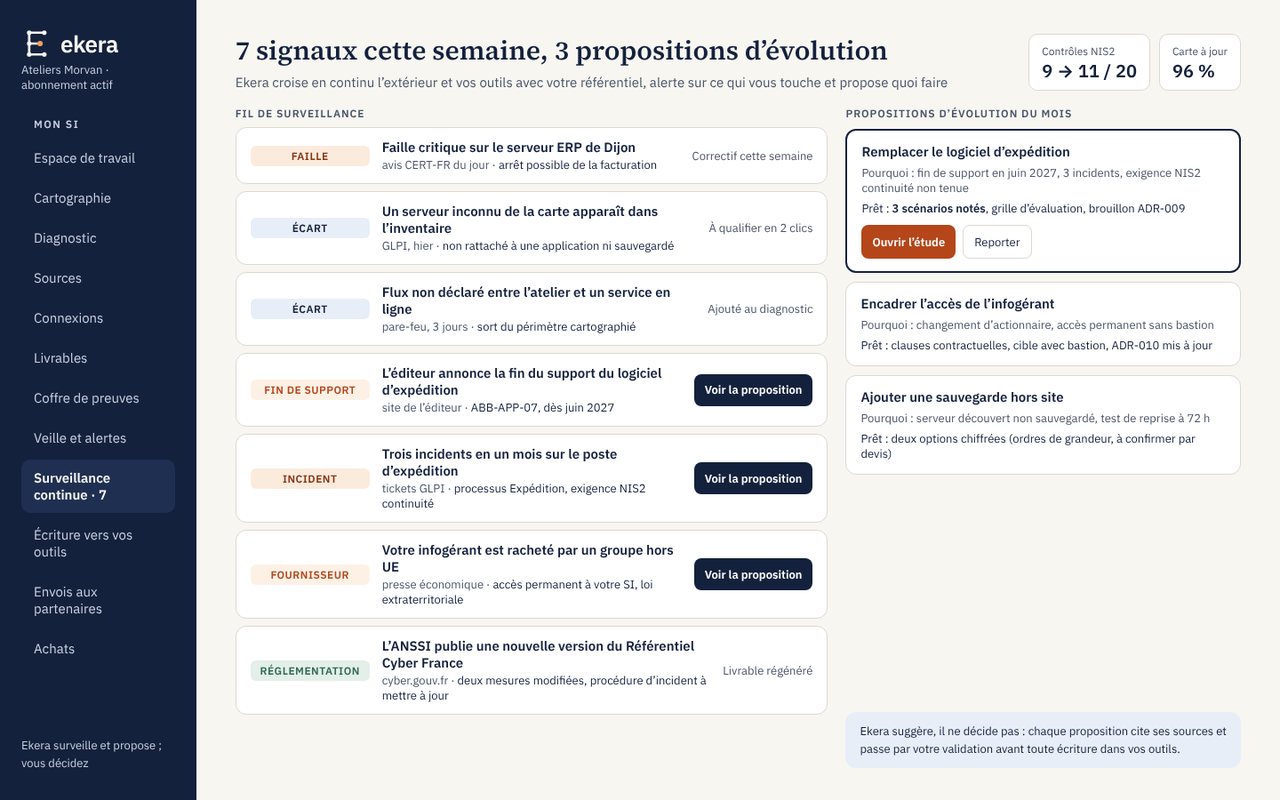
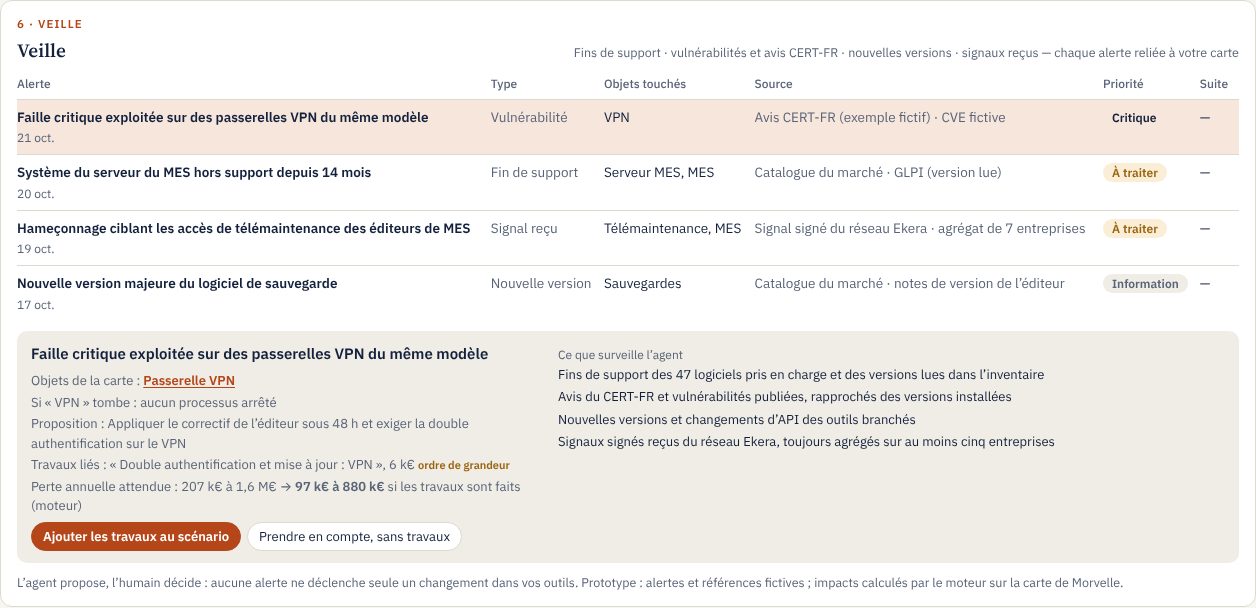
Monitor Changes in your connected sources, published vulnerabilities, end-of-support dates, NIS2 texts and your suppliers.
Identify impacts Only what affects you, linked to the components and processes concerned: a vulnerability on your ERP, a server missing from the map.
Propose actions The analyses and scenarios needed to decide whether a measure should be launched, ready for your approval flow.

Every alert and recommendation links to the information it rests on. Their scope depends on the sources and connectors plugged in at your company. See the screen

Shared security

Learning together, without confusing sharing with protection

Companies face risks that resemble each other: what one observes helps others understand the threats they meet. Ekera organises this sharing within a framework: signals validated before they are shared, to limit errors and manipulation; sharing only under the conditions each customer authorises; feedback that improves everyone’s analyses and recommendations. Sharing a signal does not, on its own, guarantee that an attack is detected or blocked.

Shared security

The security resources of a large group, shared among mid-sized companies

30% of our revenue is devoted to Ekera’s research, quality and security. It is a commitment on Ekera’s spending, for the benefit of every customer: it is neither a legally separate fund nor a reserve held on customers’ behalf. It mostly pays for people: R&D engineers who improve the reading of your documents, the calculation engine and the connectors; security engineers; analysts who validate the signals shared between customers. The rest funds Ekera’s tests, audits, qualified hosting and certifications.

These needs grow with Ekera: Ekera becomes a more attractive target, there are more tools to support, and operators of vital importance have stricter requirements. Every fix then benefits all customers, at no extra cost.

Pooled security30% of Ekera’s revenue goes to a shared budget that funds tests, audits and monitoring for everyone's benefit.All customersEach pays its subscription30% of our revenueDevoted to R&D, qualityand securityA shared budgetThe same for every customerWhat it fundsTest bench, trapped fictitious companies,penetration tests, PASSI audit,ISO 27001, qualified hostingEvery customer benefitsEvery vulnerability fixed is fixed for all;large-company security, for each customer

What is planned for Ekera’s security:

  • an external penetration test of Ekera by a provider;
  • an audit by a PASSI-qualified provider, then regular audits and penetration tests;
  • a large-scale test bench with hundreds of fictitious companies;
  • a permanent bug bounty;
  • ISO 27001 certification of Ekera;
  • SecNumCloud-qualified hosting for operators of vital importance;
  • a dedicated security team.

The tests, audits, certifications and qualified hosting listed are planned; they cover Ekera, not our customers’ architecture. With each customer’s consent and only in aggregate, from five companies, lessons learned also improve Ekera for everyone. Our R&D.

Learn more: the common budget in detail

Shared vigilance

The vigilance of a very large IS, at the price of a mid-sized one

By sharing what they learn, Ekera’s customers will benefit from the vigilance of a large group without its teams. It works like a community navigation app: every driver who reports a traffic jam or a safety hazard helps all the others. At Ekera, when a customer spots an attack, an exploited flaw or an incident, the signal benefits everyone, and each receives the alerts and protections drawn from the others’ experience.

The difference that matters to a CISO: verified signals, to limit the risk of manipulation. Each signal is checked by two people at the customer, then by an Ekera analyst, and signed. It is shared only with the customer’s consent, given by a designated person, and only in aggregate, from five companies. No raw data leaves your premises. Signal analysis is funded by the shared 30% budget.

Every customer strengthens the othersCustomers share validated, anonymised signals; Ekera's network analyses them and sends alerts and protections back to everyone.Each customerSpots an attack, a flaw,an incident on its sideA validated, anonymised signalFour-eyes checked at the customer,then by an Ekera analyst, signedThe Ekera networkAggregated from five companies,with the customer's consent; analysedAlerts and protections for allEach customer benefits fromeveryone else's vigilanceSignal analysis funded by the shared budget

Learn more: shared vigilance and its four safeguards

Ekera and cybersecurity firms

Complementary, not competing

Security plays out on three levels. AI accuracy: Ekera’s strength, tested on a bench of fictitious companies, hundreds in time, as in an AI lab. Security of the Ekera product: secure development already in place (code review by a dedicated role, automated analysis, secret scanning, verified dependencies, bypass tests, independent review), then an outside view planned and then by the shared budget: a penetration test of Ekera by a provider, a PASSI audit, ISO 27001 certification of Ekera (the roadmap). Security of your systems: Ekera does not run penetration tests and never enters your network. It reads, read-only, and computes what an attack would stop without launching it. PASSI-qualified providers remain essential, and become our partners.

Who tests whatThree areas: AI accuracy, tested by Ekera; security of the Ekera product, by Ekera then by outside providers; customer security, by cybersecurity providers, targeted by Ekera.AI accuracyEkera, its strengthTest bench of hundreds of fictitiouscompanies, some of them trapped,like an AI labCybersecurity firmsNot their businessSecurity of the Ekera productEkera, already in placeCode review by a dedicated role,automated analysis, secrets, dependencies,bypass tests, independent reviewOutside providers, plannedPenetration test of Ekera, PASSI audit,ISO 27001: plannedCustomer securityEkeraRead-only, never enters your network:computes what an attack would stop,without launching itPASSI providers, partnersTest for real: penetrationtests, audits, exercises

Better-targeted penetration tests, and monitoring between campaigns

Ekera does not replace penetration testing: it targets it. It tells you what to test first, the attack paths and single points of failure that matter, and the estimated potential loss from an outage; you avoid paying to test what has no impact. The provider’s findings flow back into the map and the costing in euros, with the work to be done, and Ekera monitors continuously between two annual campaigns. The result: shorter or more useful penetration tests, and monitoring the rest of the year. Ekera does not certify your architecture and never tells you that you no longer need to test.

Ekera and penetration testingEkera targets the penetration test, a provider runs it, its findings flow back into the map and the costing, and Ekera monitors between two campaigns.1. Ekera targetsWhat to test first: attack paths,single points of failure, cost of an outage2. The provider testsA real penetration test, shorteror more useful, on what matters3. Findings come backInto the map and the costing in euros,with the work to be done4. Ekera monitorsContinuously, between two campaigns↻ and the next campaign is better targeted

Learn more: who tests what, and Ekera with penetration testing

Understand shared security

Cyber insurance

Documented indicators to characterise your risk better

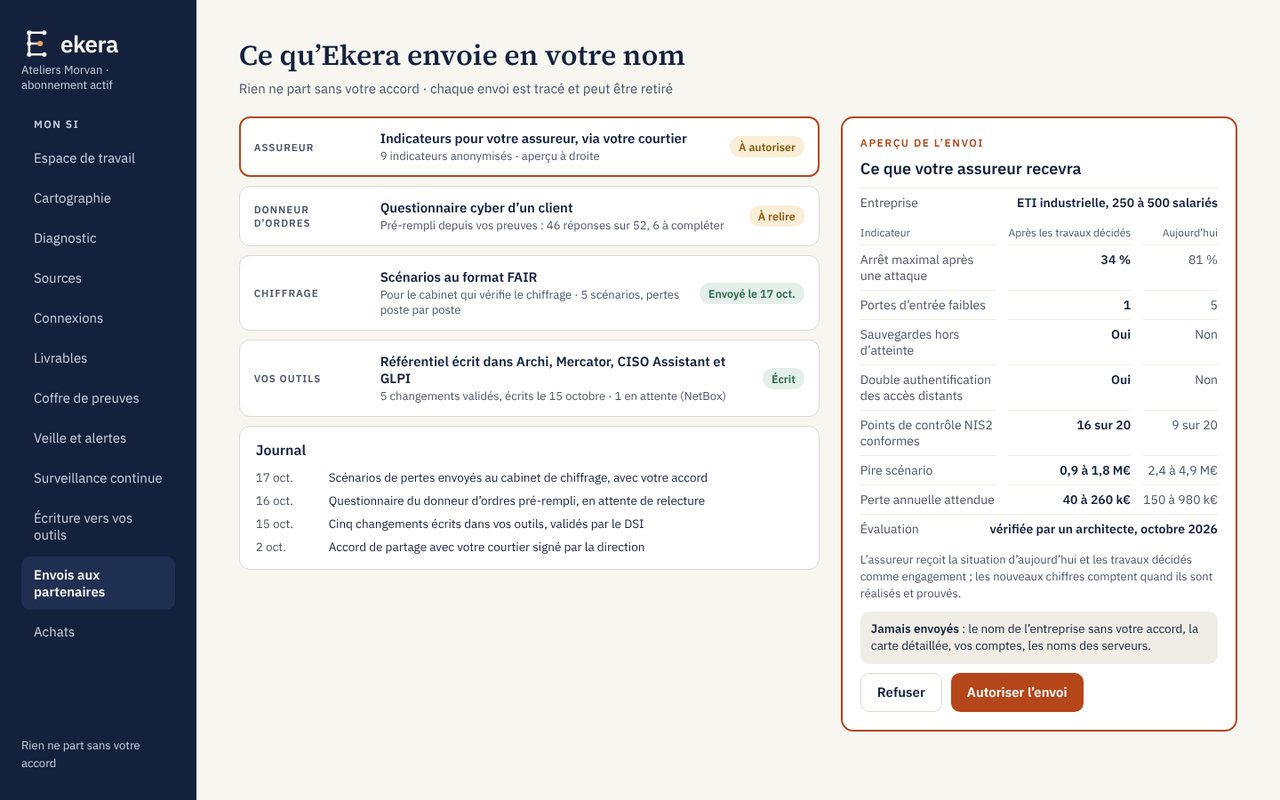
With your consent, Ekera sends your insurer or broker structured indicators on your information system and your exposure: critical dependencies, some security measures, assessment results and their date, risk scenarios and financial estimates, corrective measures carried out and their evidence. This complements existing questionnaires, pre-filled from the assessment and reviewed by you before anything is sent.

Sharing follows the permissions defined with you. Sending indicators does not mean sending the detailed map of your IT or your raw data.

For insurers, the aim: better-documented files, follow-up of prevention measures and, in time, pricing better suited to the risk profile. Pricing and cover remain the insurer’s responsibility.

What is sent, with your consent

  • Today’s indicators, and the work decided as a commitment: the new figures count once the work is done and proven
  • The worst case and the expected annual loss
  • The date of the assessment, checked by an architect

What is never sent

  • The company name without your consent
  • The detailed map of your systems
  • Your accounts and the names of your servers
Are you an insurer or a broker?

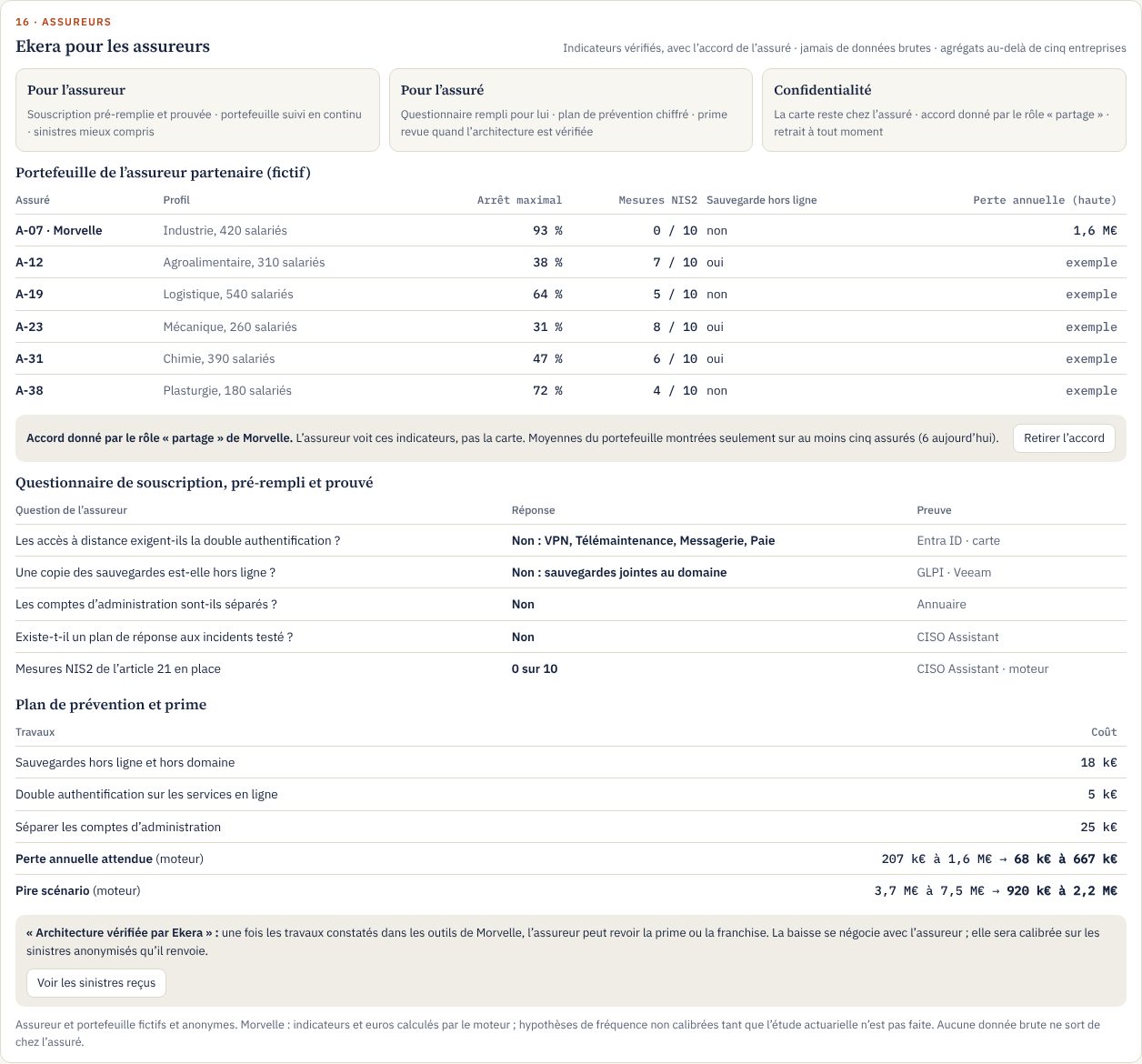
Ekera for insurers: underwrite and prevent on sourced facts

The offer

  • Underwriting: the insurer’s questionnaire pre-filled, every answer with its evidence
  • Portfolio: sourced indicators tracked over time (maximum outage, backups, two-factor authentication, NIS2 measures, potential losses in euros estimated by the engine)
  • Prevention: a costed work plan for the policyholder; once completed and confirmed, the architecture is “verified by Ekera”, that is, assessed from the available sources and the measures observed, over a stated scope and on a stated date; this is not a certification. The insurer alone decides what follows, premium and deductible included; Ekera promises no reduction
  • Claims: your anonymised claims, translated into Ekera’s ontology, to calibrate the model

Confidentiality guarantees

  • Nothing is sent without the policyholder’s consent, given by a designated person (“sharing” role), and revocable at any time
  • Indicators, never the detailed map or the raw data
  • Portfolio averages only above five companies
  • Open AI models served in France; hosted in France
Ekera for insurers screen: portfolio, evidenced underwriting questionnaire and prevention plan, fictitious data
Fictitious insurer and portfolio. Policyholder indicators calculated by the Ekera engine.

Learn more: the new cyber insurance product

Build an underwriting trial
Partners

IT services firms and managed service providers, accountants, insurers and brokers

IT services firms and managed service providers: deliver assessments to your clients under your brand or ours, for a fee per assessment, and carry out the work they decide on.

Chartered accountants: your clients’ cyber risk, priced from their accounts, to advise them on their investments and their insurance.

Insurers and brokers: sourced indicators on your policyholders’ architecture, with their consent, in Ekera Assurance.

Become a partner