 ekera
A new product for insurers: the cyber premium falls when the architecture is continuously verified
Today, a cyber premium is set on a self-declared questionnaire filled in once a year. With Ekera, an insurer can offer its policyholders something new: an architecture verified continuously, evidenced indicators, and a premium that reflects them. The discount is set by the insurer.
A market opening up to mid-sized companies
According to AMRAE’s LUCY 2026 study, published on 2 June 2026, indemnified cyber claims of French mid-sized companies rose about 2.5-fold in one year (248 in 2025 against 100 in 2024), and their policy take-up grew by 75%. The complexity of underwriting questionnaires was long seen as a real barrier to entry (Le Monde Informatique, 5 June 2026, in French). Answers that are already evidenced remove that barrier: the insured no longer declares everything from memory, and the insurer underwrites on facts.
The precedent: motor insurance
In 2026, an American insurer launched an offer that cuts the rate for miles driven with driver assistance by about half, thanks to vehicle data (press release, 21 January 2026). The principle: when risk is measured as it happens, it can be priced better.
The same principle for cyber: “assisted mode”
An architecture verified continuously by Ekera plays, for cyber insurance, the role driver assistance plays for motor insurance: a risk measured every day from the insured’s tools, evidenced item by item, and followed over time. The insurer no longer prices a declaration, but an observed situation.
What the insurer gets
- Verified indicators, with the insured’s consent: maximum downtime after an attack, backups out of reach, multi-factor authentication on remote access, NIS2 measures in place, worst-case scenario and expected annual loss in euros. Never the detailed map or raw data.
- A pre-filled, evidenced underwriting questionnaire: every answer points to its evidence (a tool export, a document, a finding).
- A prevention plan computed by the engine: the works that reduce expected loss the most, with their cost; once completed and checked, the architecture is “verified by Ekera”.
- Continuous follow-up: a degradation (a backup no longer taken off-site, access without multi-factor authentication) shows up without waiting for renewal.
- Its anonymised claims, translated into Ekera’s ontology: they come back as attack paths and missing building blocks, validated by an architect and an actuary, to calibrate the model.
- Portfolio averages only above five companies.
What the insured gets
- A lower premium when its architecture is verified; the discount is set by the insurer.
- Its NIS2 evidence, kept up to date, reusable for its own customers.
- Prioritised works: what reduces risk in euros the most, first.
- A questionnaire it reviews instead of filling in.
The offer journey
Confidentiality guarantees
- Nothing leaves without the insured’s consent, given by a designated person (“sharing” role), and withdrawable at any time.
- Indicators, never the detailed map or raw data.
- Portfolio averages only above five companies.
- Data hosted in France; open AI models; figures computed by a deterministic engine, never by a model.
The demo
The demo workspace shows the offer with a fictitious insurer, portfolio and claims (screens in French).
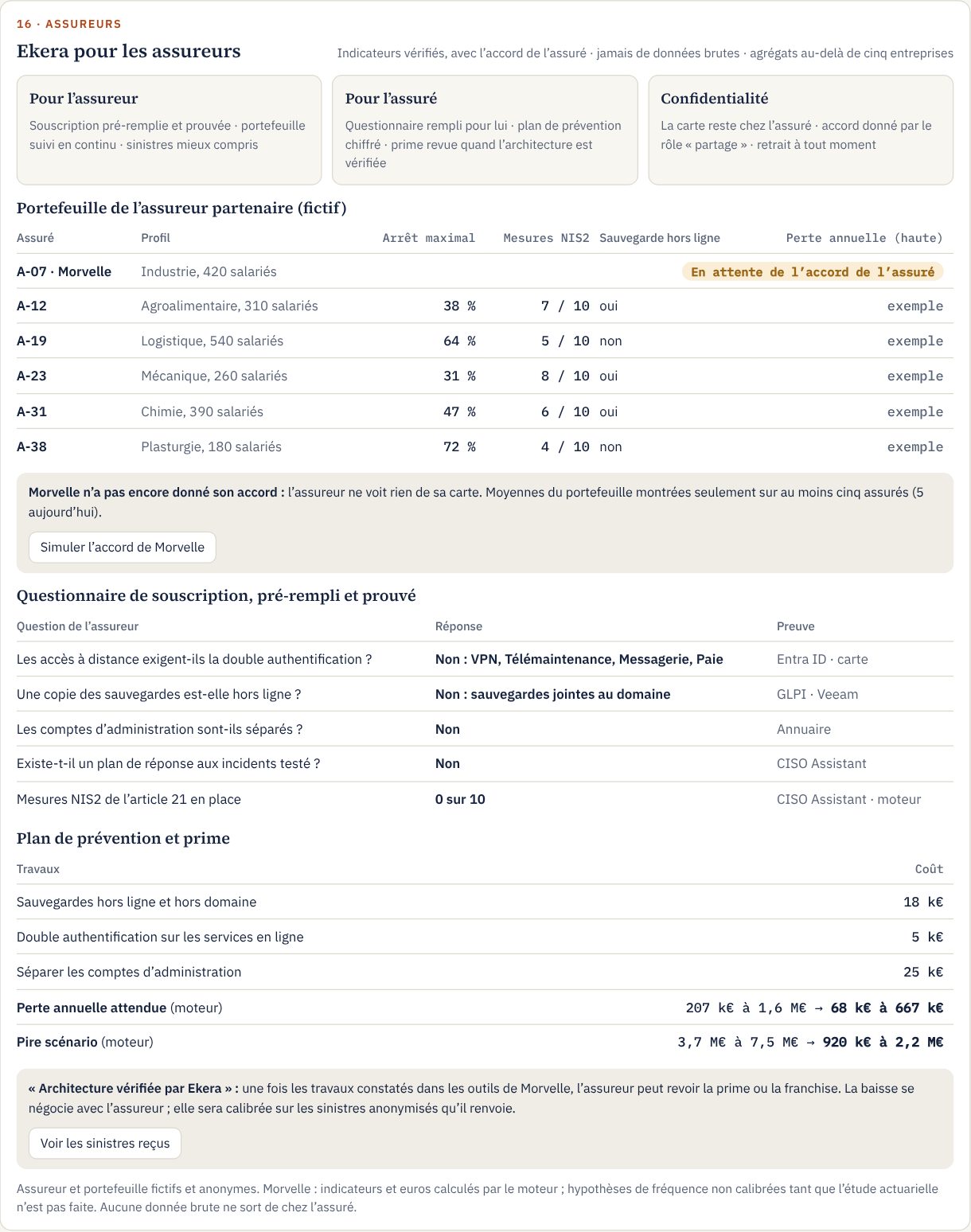
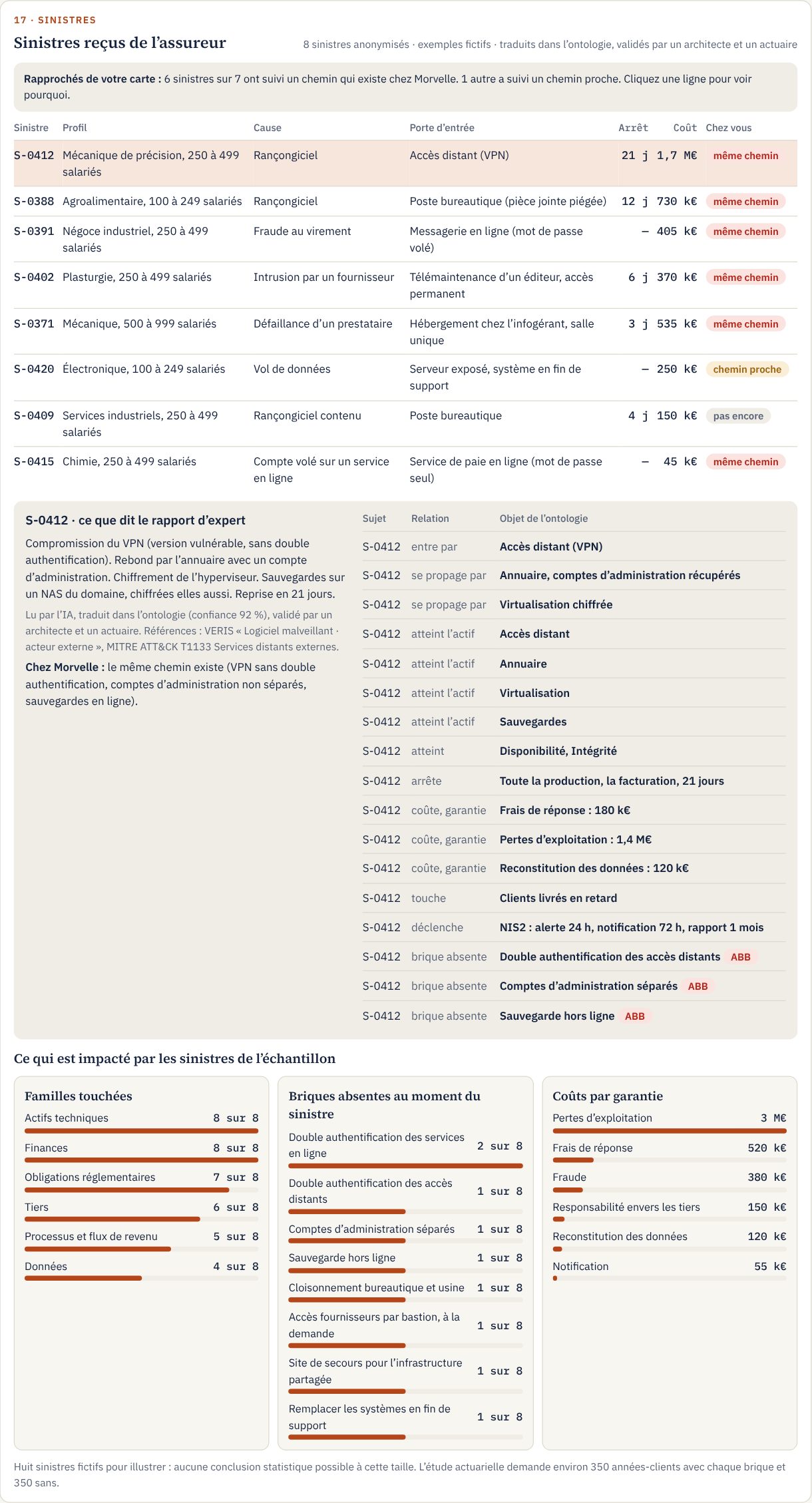
Open the demo workspace, then the “Assureurs” and “Sinistres” tabs.
What Ekera does not do
- Ekera is not an insurer and sets neither the premium nor the discount: the insurer decides.
- Ekera issues no certification or rating: every indicator points to its evidence.
- Ekera does not perform penetration tests and does not enter the insured’s IS: it reads, read-only.
- This partnership is in preparation: no partner insurer has been announced to date.
Sources
- Le Monde Informatique, “Les ETI s’assurent davantage contre les risques de cybersécurité”, 5 June 2026 (in French), on AMRAE’s LUCY study published on 2 June 2026
- Press release from an American insurer on pricing driver-assisted miles, 21 January 2026
See also: shared security and Ekera for insurers on the home page.