 ekera
Interdependent information systems
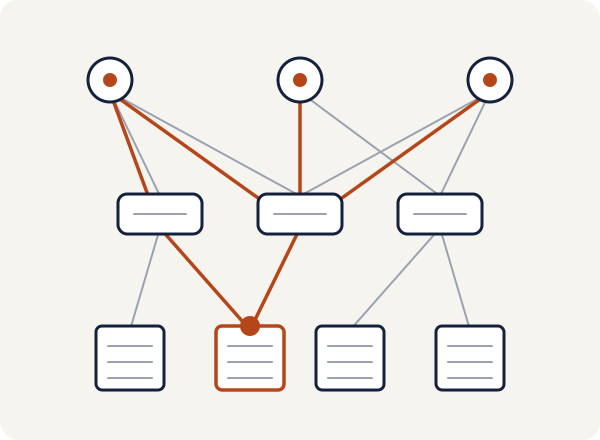
An outage or a compromise can affect several applications, infrastructure components and business processes. Understanding these dependencies helps anticipate the consequences of an incident.
Ekera builds a documented map of your information system, finds the critical dependencies, analyses attack and outage scenarios, estimates their consequences in euros and compares the work. AI proposes, your teams decide.
Companies need to know their IT dependencies better, justify their security investments and document the measures they put in place. Yet decisions remain hard: technical teams describe vulnerabilities, while management arbitrates budgets without always having a shared estimate of the economic consequences.
An outage or a compromise can affect several applications, infrastructure components and business processes. Understanding these dependencies helps anticipate the consequences of an incident.
Companies must identify their risks, justify their security measures and document their decisions. A structured map makes this easier and lets you track how the system changes.
Security measures keep multiplying, but they do not all have the same cost or the same effect on risk. Comparing them helps target investment.
Meanwhile, cyber insurance rates are falling: −4% worldwide in the second quarter of 2026, the twelfth quarter of decline in a row. In a more competitive market, telling risk profiles apart can become an advantage for insurers; verifiable information on architecture can contribute to it.
And attacks are changing scale: in July 2026, Hugging Face confirmed an intrusion carried out by an autonomous AI agent. Faster attacks call for better preparation: knowing the dependencies between applications, infrastructure, identities and processes before the incident, so you know at once what is affected.
In France, the law transposing NIS2 has not been passed yet. But your customers, your insurers and your buyers are already asking the same questions.
Sources: AMRAE, LUCY 2026 study (2025 data); Marsh, Q2 2026 ; Hugging Face, 16 July 2026; Security Magazine and IT-Connect, July 2026; Vincent Strubel, Director General of ANSSI, before the French Senate, December 2024; Référentiel Cyber France (ReCyF) v2.5, objective 5, measure 5.A.1, working draft of 17 March 2026.
Ekera brings these three issues together: understanding the system, estimating the consequences of an incident and choosing which measures to fund.
Identify the gaps between your situation and the applicable requirements, map critical dependencies and organise the evidence needed to track them. Ekera helps structure the assessment and prepare your roadmap; it does not, on its own, deliver a compliance certification.
Discover the NIS2 assessmentIn a deal, IT risks weigh on business continuity, future investment and the value of the company. Ekera structures the available information, identifies points of attention and estimates remediation costs, from the accessible documents, with no direct access to the target’s systems.
Discover IT due diligenceAutomate part of the collection, analysis and documentation to spend more time on decisions. Ekera links business needs, applications, infrastructure and technical solutions; it prepares change scenarios and the related documents, which your architects check and approve.
Discover enterprise architectureEkera helps companies understand their information system, estimate the financial consequences of its weaknesses and choose the work that reduces their exposure the most. From your documents, your tools and your teams’ knowledge, it builds a documented map, finds the critical dependencies, analyses attack and outage scenarios, then estimates their consequences from your data and explicit assumptions. Results are sourced, assumptions are visible, and decisions stay in your hands. Every module below follows from this mechanism.
One product, one map: modules are switched on as you need them.
Are you a broker or an insurer? Become an Ekera partner
Ekera uses your documents, your exports and, when you decide so, data from your tools. It builds a documented map of your information system, analyses its dependencies and prepares change decisions. Results are tied to their sources; missing information, assumptions and the limits of the analysis are flagged. Not every step is automated: the interview with your teams, checking the results and the decisions remain human.
| Step | Your question | What Ekera provides |
|---|---|---|
| Collect | What information do we gather? | Your documents, your exports and, if you decide so, data from your tools; what is missing or contradictory is flagged. |
| Map | What does my system depend on? | A documented map of applications, dependencies and business processes, every item linked to its source. |
| Assess | What would an incident cost? | Attack and outage scenarios, explicit assumptions and financial estimates. |
| Prioritise | Which work should we fund first? | The measures assessed, compared by cost and estimated effect for three budgets, and a roadmap. |
Your documents (contracts, architecture files, security policy, meeting minutes), your exports (inventory, directory, firewall, cloud, tickets, purchasing, accounting entries), read-only connectors to your tools, and an interview with your CIO for what the documents do not say. What is missing or contradictory is flagged.
A calculation engine, independent of the language model, produces the figures; data, assumptions and sources are shown, and every quotation is checked word for word against its document. Identify the measures, among those assessed, that reduce your exposure the most. It is a reasoned basis for prioritising, not a guarantee of the actual cost of a future incident.
Ekera writes into GLPI, CISO Assistant or Mercator what you have decided, and only after a person’s signed approval, through the process agreed with you. Every write is traced: who approved it, when, what changed. Ekera never deletes anything; a mistake is undone or compensated by a reverse operation when the tool allows it.
A list of vulnerabilities is not enough to decide which measures to fund. Ekera estimates the financial consequences of the scenarios studied from your data, notably accounting and operational data, and explicit assumptions.
Depending on its duration, its scope and the assumptions made. The worst scenario is broken down line by line and compared with your insurance limit.
What the scenarios studied would cost on average each year, as a range: estimated potential losses, conditional on the assumptions used (provisional calibration, not validated by an actuary).
Given the frequencies and consequences used in the model: for each scenario, estimated frequency × loss, added up. They are given as a range because frequencies, downtime and response costs are uncertain.
The estimated drop in risk in the modelled scenarios, if the measures considered are implemented. It is a change in risk, not an avoided expense.
A cancelled licence, a purchase that no longer happens: it shows in your accounts, as distinct from a theoretical gain or time freed up. These four figures are not interchangeable; each comes with its definition, assumptions and limits.
The figures are produced by the calculation engine, independently of the language model: same data, same result.
Reproducible does not mean exact: the result is only as good as the data and assumptions. The French accounting entries file (FEC), which every company can produce, gives revenue and variable costs; the margin is split across your revenue streams, each counted once. Data, parameters and sources are shown so you can discuss them with your technical and finance teams.
Today, the costs shown are illustrative orders of magnitude, to be confirmed by quotes. If the ranking of the variants changes between the low and high ends of the price ranges, Ekera flags it.
The goal: a well-argued basis for comparing investments, without confusing an estimate with a guaranteed result.
One assessment, several viewpoints: for each function, Ekera prepares the page that concerns it, calculated by the engine. A work scenario goes through your approval flow before anything is written into your tools.
Each person approves, rejects or asks for a change from their email or Teams. The flow adapts to your organisation: the CFO only above a certain amount, for example. Decisions and opinions are traced; nothing is written into your tools before.
A first 30-minute call: framing your need, the possible scope and the list of information needed for the assessment. The initial assessment starts from your documents and exports, with no direct access to your information system.